
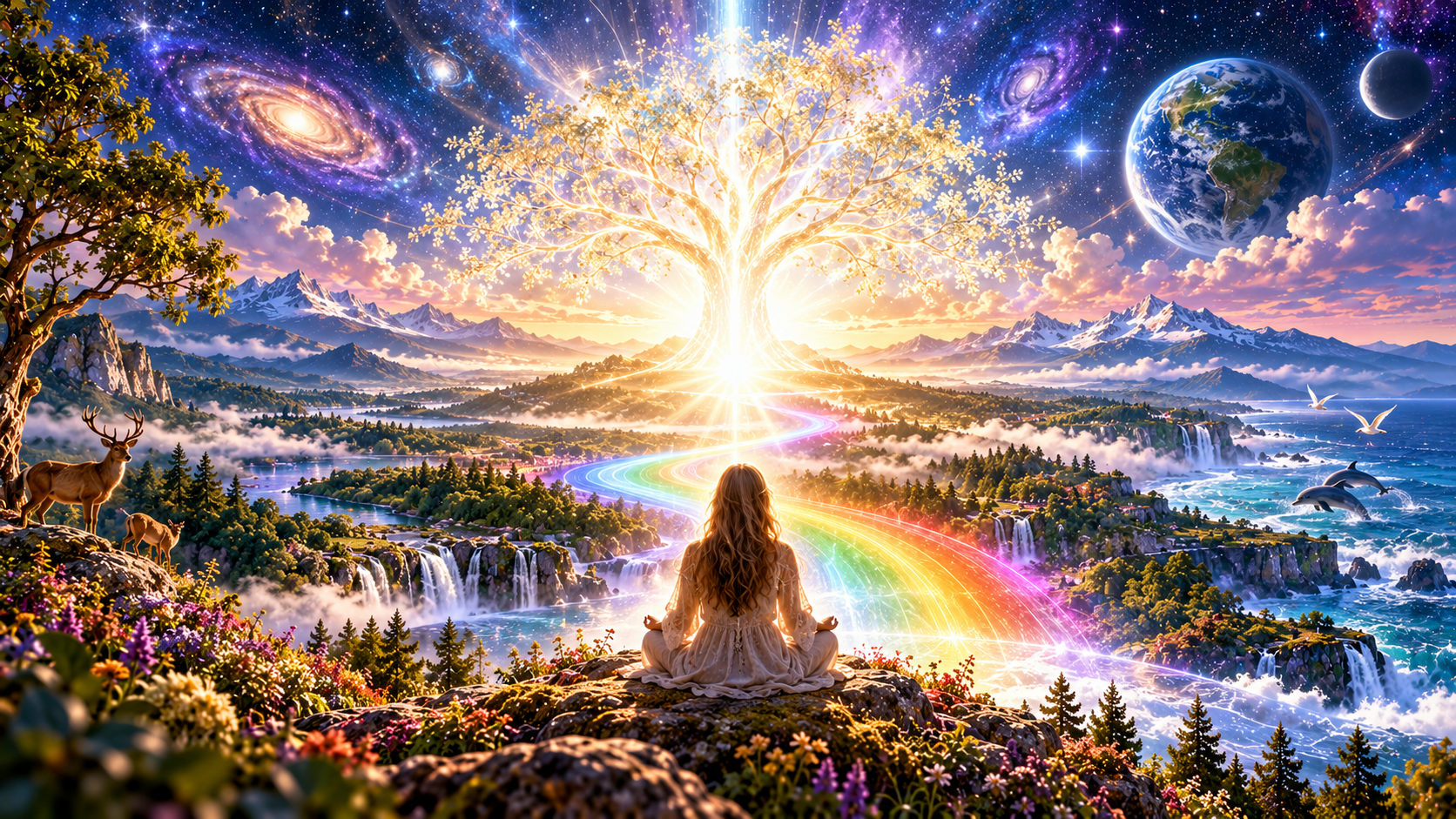
The Rainbow Bridge of Life — Beyond the Seven Stages
Colour: White | Principle: Oneness | Purpose: To Be | Guiding Value: Unity
Beyond the colours of the Rainbow Bridge lies a final reflection upon the nature of existence. Having explored the foundations of life, the development of individuality, our relationships and the wisdom of experience, we arrive at a profound question: What does it mean to belong to something greater than ourselves?
Beyond the Rainbow Bridge: The Return to Oneness
Every life begins within a Universe that existed long before our arrival.
From the moment we enter the world, we become participants in an extraordinary network of relationships and natural processes.
Our bodies are formed from matter that belongs to the physical Universe.
Our lives depend upon energy, biological activity and the environments that sustain us.
Our minds develop through experience, allowing us to perceive, interpret and respond to the world around us.
Throughout our existence, we develop a unique sense of individuality.
We discover our abilities, establish relationships, pursue aspirations and contribute to the lives of others.
Yet beneath the differences that distinguish one individual from another lies an undeniable connection:
We all belong to the same Universe.
Within my philosophical framework, The Twelve Numbers of Creation, I explore existence through the relationship between consciousness, energy and matter.
The framework begins with the Universe as a unified whole, before examining the principles through which we experience physical reality and the journey of human life.
The final seven numbers form the Rainbow Bridge of Life, a symbolic progression through seven principles of personal growth and experience.
At Number Six, Red — Survival: To Have, we explore the foundations that sustain our existence.
At Number Seven, Orange — Creativity: To Do, we discover our capacity to explore, imagine and create.
At Number Eight, Yellow — Identity: To Show, we develop and express our individuality.
At Number Nine, Green — Relationships: To Serve, we learn to share love, care and responsibility with others.
At Number Ten, Blue — Connectedness: To Support, we recognise our place within the wider world.
At Number Eleven, Indigo — Guidance: To Teach, we transform experience into understanding that may benefit others.
At Number Twelve, Violet — Release: To Let Go, we explore acceptance, impermanence and the art of releasing what cannot remain unchanged forever.
Now, beyond these twelve principles, we arrive at a final symbolic expression:
White — Oneness.
Its guiding principle is:
To Be.
And its central value is:
Unity.
To recognise our connection to the greater whole.
To appreciate the relationship between individuality and interconnectedness.
To contemplate the origins and meaning of existence.
To explore the possibility of consciousness beyond physical life.
And to discover what it means simply to exist.
Oneness represents the culmination of the Rainbow Bridge — not as a scientifically established destination, but as a philosophical and spiritual invitation to reconsider our relationship with the Universe.
Why Oneness Exists Beyond the Twelve Numbers
The Twelve Numbers of Creation begins with unity and gradually explores the diversity of existence.
From One Universe, we move towards the complementary principles of Consciousness and Energy.
We consider the relationship between Mind, Body and Spirit.
We explore the natural elements, our sensory experiences and the seven stages of the Rainbow Bridge.
Each number introduces another dimension of our experience.
Yet the purpose of the framework is not simply to separate existence into individual categories.
It is to explore how these different dimensions may be understood as parts of a greater whole.
Within my philosophy, White represents the symbolic reunion of everything explored throughout the journey.
Just as white light can be separated into the colours of the visible spectrum, I use the Rainbow Bridge to represent the diversity of human experience emerging within one interconnected reality.
The colours remain distinct.
Each contributes something unique.
Yet together, they form a broader expression of light.
This is a symbolic analogy, rather than a scientific explanation of consciousness or the electromagnetic spectrum.
The Rainbow Bridge begins with our individual needs and ends by inviting us to recognise our participation in the greater whole.
The Three Aspects of Being: Mind, Body and Spirit
At the beginning of the Twelve Numbers of Creation, I introduce three interconnected aspects of human existence:
Mind, Body and Spirit.
Within my Conscious Energy philosophy, these aspects provide a symbolic framework for exploring how awareness, physical experience and activity contribute to our lives.
Mind — The Experience of Consciousness
The mind allows us to perceive, remember, interpret and reflect upon our experiences.
Through awareness, we develop a sense of individuality.
We recognise ourselves as distinct beings with personal memories, beliefs and perspectives.
Our experiences contribute to the ongoing development of our identities.
Within my framework, I associate consciousness with qualities such as observation, information, reflection and stillness.
These associations are philosophical interpretations, not claims that consciousness is scientifically equivalent to negative electrical charge or a particular physical substance.
Body — The Physical Expression of Life
Our bodies provide the biological structures through which we experience and interact with the physical world.
They allow us to move, communicate, respond to our surroundings and participate in relationships.
Our bodies are composed of matter originating from the natural Universe.
The elements that form living organisms participate in physical and ecological processes extending across enormous periods of time.
In this sense, our physical existence is inseparable from the wider natural world.
Spirit — The Expression of Energy and Meaning
Within my philosophy, Spirit represents the motivating and expressive dimension of existence.
It is associated with activity, transformation, purpose and the capacity to participate in life’s unfolding experiences.
I also use the concept of Spirit to explore the possibility that there may be aspects of personal existence that extend beyond the physical body.
This latter interpretation belongs to my spiritual beliefs rather than established scientific knowledge.
Together, Mind, Body and Spirit provide a symbolic way of exploring the relationship between awareness, physical existence and personal meaning.
The mind perceives. The body experiences. The spirit expresses.
Within Oneness, I contemplate whether these dimensions may ultimately be understood as interconnected expressions of a single reality.
Consciousness, Energy and the Mystery of the Source
One of the central questions guiding my philosophy is whether consciousness and energy might represent complementary principles within a deeper understanding of existence.
In my framework, Consciousness is associated with receptive and observational qualities.
Energy is associated with movement, activity and transformation.
Matter represents the physical structures through which we experience the world.
I use the relationship between these concepts to explore balance, interaction and the emergence of individual experience.
However, science uses these terms in more specific ways.
Energy is a measurable physical property associated with the capacity of systems to undergo change.
Matter consists of physical entities described through established scientific theories.
Consciousness, particularly subjective awareness, remains an active area of scientific and philosophical investigation.
There is currently no established scientific evidence that consciousness and energy are two opposing universal forces in the way my framework symbolically describes them.
Nor is there evidence that the nucleus of an atom or cell contains a collective consciousness.
Nevertheless, the scientific understanding of physical relationships can inspire philosophical questions about the deeper nature of existence.
Within my framework, I call this deeper unity the Source.
The Source represents the possibility of an underlying reality from which individual forms of existence emerge.
Some spiritual traditions may describe a similar idea through concepts such as God, divine consciousness, universal spirit or ultimate reality.
Others may understand unity through the physical interconnectedness of matter, energy and natural processes.
My intention is not to suggest that these interpretations are scientifically identical.
Rather, I wish to explore the possibility that different perspectives may encourage us to contemplate the same fundamental question:
What is the relationship between the individual and the whole?
The Collective Consciousness: A Universe of Shared Experience
Throughout human history, knowledge has been accumulated, preserved and passed between generations.
Our languages, cultures, traditions and technologies reflect countless contributions from people who lived before us.
Every individual enters a world shaped by experiences they did not personally witness.
We inherit knowledge through education.
We develop values through relationships.
We encounter ideas preserved through books, stories, art and cultural traditions.
We benefit from discoveries made by people whose names we may never know.
Within my philosophy, I use the term collective consciousness to explore this shared dimension of human experience.
At one level, the concept can be understood metaphorically as the accumulation of knowledge, cultural memory and social understanding.
At a deeper spiritual level, I imagine the possibility that individual experiences may contribute to a greater field of consciousness extending beyond any single person.
This spiritual interpretation is speculative.
There is no established scientific evidence demonstrating that human memories or personal consciousness are stored within a universal conscious field.
Yet the metaphor remains meaningful to me.
It suggests that our individual experiences may have significance beyond the boundaries of our personal lives.
We are shaped by the experiences of others, and through our own lives, we contribute to the experiences of those who follow.
The Soul: Our Unique Expression of Existence
Every person experiences the world through a distinct perspective.
We possess our own memories, emotions, preferences, relationships and personal histories.
These experiences contribute to our sense of identity.
Within my spiritual understanding of Conscious Energy, I use the word soul to describe the unique essence of an individual’s conscious experience.
I imagine the soul as carrying the qualities developed throughout a lifetime — the love we have shared, the knowledge we have accumulated and the experiences that have shaped our understanding.
This interpretation is not intended as a scientific definition of consciousness.
Rather, it reflects my belief that individual existence may possess a spiritual significance extending beyond the physical processes of the body.
The soul, in this interpretation, represents more than our appearance, occupation or material possessions.
It symbolises the unique story of our existence.
Our physical characteristics may change.
Our roles and responsibilities may evolve.
Our relationships may begin and end.
Yet the experiences we gather contribute to the person we become.
If the body is the vessel through which we experience life, the soul represents my philosophical understanding of the meaning carried within that experience.
The End of Physical Life: Returning to Nature
Throughout the Rainbow Bridge, our bodies provide the physical means through which we participate in the world.
They allow us to explore, create, communicate, love and contribute.
Yet our biological existence is finite.
Eventually, the processes sustaining an individual life come to an end.
When death occurs, the physical body no longer functions as a living organism.
Its materials remain part of the natural world.
Depending upon the circumstances and the choices made regarding care after death, these materials undergo physical and chemical transformations.
In ecological systems, decomposition can return nutrients and other materials to the environment.
This reflects an important principle of the natural world:
Matter does not simply disappear when an individual life ends.
The physical materials that once formed our bodies continue participating in the Universe.
Within my philosophy, this represents one dimension of returning to the Source.
Our physical existence emerges from the natural world and ultimately remains part of it.
However, the continuation of matter and physical energy does not establish that personal awareness survives death.
The question of whether consciousness or a soul can exist independently of the living brain remains unresolved as a spiritual and philosophical matter, without scientific evidence demonstrating such survival.
This distinction is important because physical continuity and personal continuity are not necessarily the same thing.
Yet both invite meaningful reflection upon the nature of existence.
My Spiritual Vision of the Afterlife
Beyond the physical understanding of death lies a question that has fascinated humanity for thousands of years:
What, if anything, happens to our experience when the body can no longer sustain life?
My personal belief is that there may be dimensions of existence beyond those we currently understand.
I imagine the possibility of a spiritual realm in which the essence of an individual life may continue in a different form.
Within this vision, the soul is released from the physical limitations of the body.
It enters a state of warmth, safety and peace.
The demands of survival no longer exist.
There is no need to seek food, shelter or physical protection.
Instead, I imagine a state of stillness in which the soul can rest and reflect upon the experiences of its previous life.
Memories may drift through awareness like dreams.
People, places and meaningful moments may become part of a continuing inner experience.
The love shared throughout life may remain an important part of the soul’s identity.
This is how I personally imagine the possibility of returning to a greater source of conscious existence.
It is a spiritual vision rather than a description of events known to occur after death.
I do not claim to know whether such a realm exists or whether personal memories can continue independently of the brain.
Nevertheless, contemplating this possibility brings me to a deeper question:
If our individual lives are temporary expressions of existence, could their meaning extend beyond the duration of our physical bodies?
For me, this question remains open to exploration.
Reincarnation: The Possibility of Another Journey
Another possibility that interests me is reincarnation.
Across different spiritual and philosophical traditions, reincarnation has been understood in various ways.
Some beliefs describe the rebirth of a soul into another physical body.
Others describe continuity through processes that do not involve an unchanging individual soul.
Within my own framework, I imagine that a soul might eventually participate in another experience of physical life.
In this interpretation, the soul would not necessarily retain the same identity, memories or circumstances.
Instead, a new life would emerge with its own body, relationships and opportunities for experience.
The possibility fascinates me because it introduces the idea that individuality may be temporary while participation in existence continues.
I also wonder whether the qualities developed through one lifetime might have significance within a broader spiritual process.
However, these possibilities remain speculative.
There is no scientifically established mechanism by which a personal soul leaves one body and enters another, or by which memories are transferred between separate lives.
Reports of children describing apparent memories of previous lives have attracted interest and investigation, but they do not establish reincarnation as a proven phenomenon.
Questions of memory, suggestion, cultural influence, coincidence and interpretation remain important considerations.
Within my philosophy, reincarnation is therefore best understood as a spiritual possibility rather than a certainty.
The mystery of what may follow death does not diminish the significance of the life we are experiencing now.
Every Life Holds Value, Regardless of Its Length
When contemplating the purpose of life, it is important to recognise that not everyone has the opportunity to experience a long lifespan.
Some people die in infancy or childhood.
Others experience illness, accidents or circumstances that bring their lives to an unexpected end.
These losses can be profoundly painful for families, friends and communities.
They may also challenge our beliefs about fairness, purpose and the natural order of existence.
Within my philosophy, I believe that the value of a life should never be measured solely by its duration.
A person who lives for only a short time is no less deserving of love, dignity or remembrance than someone who reaches old age.
The meaning of a life cannot be reduced to the number of achievements completed or the stages of development experienced.
A child may profoundly influence the lives of their parents.
A friend may bring comfort and companionship during a brief period.
A loved one’s presence may leave memories that remain meaningful for decades.
When someone dies prematurely, I do not believe we should assume that they failed to fulfil their purpose.
Nor should their death be interpreted as a necessary decision made by a collective consciousness or universal intelligence.
Biological conditions, environmental circumstances and chance can influence the length of a life.
The spiritual meaning of these events remains a matter of personal interpretation.
For those who find comfort in the possibility of an afterlife or reincarnation, such beliefs may provide hope.
Others may find meaning through remembrance, love and the continuing influence of the person who has died.
Both deserve respect.
A life does not need to be long to be meaningful, and love does not become less significant because the time shared was brief.
Oneness Through Mind, Body and Spirit
Within The Earth & Body Connection, Mind, Body and Spirit provide three symbolic perspectives through which we can contemplate our place within existence.
At the stage of Oneness, these aspects invite us to reflect upon the relationship between individual experience and the greater whole.
Mind — Awareness of Our Interconnectedness
Through reflection, we can recognise that our experiences are influenced by relationships, culture, biology and the environments in which we live.
Our understanding of ourselves expands when we consider the perspectives and experiences of others.
Body — Our Physical Belonging to the Universe
Our bodies are composed of matter originating from the natural world.
We depend upon the same physical laws and ecological systems that support other forms of life.
Our physical existence is therefore inseparable from the Universe in which it occurs.
Spirit — The Search for Meaning Beyond the Individual
Within my philosophical framework, Spirit represents our capacity to explore meaning, purpose and the possibility of a deeper connection to existence.
For some, this may involve belief in a divine source or continuing soul.
For others, it may be expressed through awe, compassion, nature, creativity or a sense of belonging to humanity.
Together, these three aspects offer different ways of contemplating the same fundamental relationship:
We experience life as individuals, yet our existence remains connected to something far greater than ourselves.
Oneness Does Not Require Sameness
One of the most important lessons of the Rainbow Bridge is that individuality and unity are not necessarily opposing ideas.
Throughout the Identity stage, we explored the importance of recognising our unique personalities, values and experiences.
Through Relationships, we discovered how individuals can form meaningful connections without losing their independence.
Connectedness expanded our awareness towards communities, humanity and nature.
Now, Oneness invites us to consider how diversity and unity might coexist.
Imagine a forest.
Every tree possesses its own structure, age and pattern of growth.
Different species occupy different ecological roles.
Yet the forest exists through relationships between plants, animals, fungi, microorganisms, soil, water and climate.
Its diversity contributes to the complexity of the ecosystem.
Humanity reflects a similar relationship between individuality and interdependence.
We possess different identities, cultures, beliefs, abilities and experiences.
Yet we share a common biological ancestry and depend upon the same planet.
Our differences do not need to disappear for us to recognise our shared humanity.
Within my philosophy, Oneness represents the possibility of embracing diversity while recognising the relationships that connect us.
Unity does not require sameness. It requires recognising that our differences exist within a shared world.
Wisdom, Beauty and Love: Three Expressions of Oneness
Throughout my work, three values repeatedly emerge as central to the kind of world I hope humanity can create:
Wisdom, Beauty and Love.
Within the Rainbow Bridge, these values are especially significant in the later stages of our journey.
Wisdom — Understanding Our Place
Wisdom encourages us to develop knowledge, reflect upon our experiences and recognise the consequences of our actions.
It reminds us that our understanding is incomplete and that we can continue learning from others.
A wise society would value education, evidence, thoughtful leadership and the sharing of knowledge across generations.
Beauty — Appreciating the World We Share
Beauty encourages us to recognise value in nature, creativity, relationships and everyday experiences.
It reminds us that fulfilment does not depend entirely upon material accumulation.
A society guided by Beauty would seek to protect natural environments, encourage creativity and develop communities that support wellbeing.
Love — Caring Beyond Ourselves
Love encourages compassion, respect and responsibility towards others.
It invites us to recognise the dignity of people whose experiences differ from our own.
A society guided by Love would seek to reduce unnecessary suffering, support vulnerable members and create opportunities for meaningful connection.
Together, these values provide a practical expression of Oneness.
Wisdom helps us understand. Beauty helps us appreciate. Love inspires us to care.
Living in Oneness: A Practice for the Present
Although Oneness appears beyond the seven colours of the Rainbow Bridge, we do not need to wait until the end of life to explore its meaning.
We can practise greater awareness of our interconnectedness through everyday choices.
We might begin by recognising how our actions influence others.
We can make time to appreciate the natural environments that sustain us.
We may become more curious about perspectives different from our own.
We can practise compassion without expecting everyone to share our beliefs.
We might reduce unnecessary consumption, support our communities or contribute to the wellbeing of animals and ecosystems.
We can also develop a healthier relationship with ourselves.
Oneness does not require abandoning our identity or personal aspirations.
It invites us to recognise that our wellbeing exists within a wider network of relationships.
Sometimes this awareness emerges through extraordinary experiences.
At other times, it appears in the simplest moments.
Watching sunlight move across a landscape.
Listening to birds in a garden.
Sharing a meal with someone we love.
Offering kindness to a stranger.
Recognising that the same natural world sustains countless forms of life.
Oneness can begin with the simple recognition that we are not separate from the world we inhabit.
The Complete Journey: From One Universe to Oneness
The Twelve Numbers of Creation begins with a question about the nature of existence.
It gradually expands into a symbolic exploration of the Universe, the physical world and the human journey.
The first five numbers establish the conceptual foundations of my framework.
1 — One Universe
The greater whole within which existence unfolds.
2 — Two Forces
Consciousness and Energy, understood as complementary principles within my philosophy.
3 — Three Aspects of Being
Mind, Body and Spirit — symbolic dimensions of human experience.
4 — Four Elements
Air, Water, Earth and Fire — traditional symbols representing qualities and processes within the natural world.
5 — Five Senses
Sight, hearing, smell, taste and touch — familiar pathways through which we experience our surroundings, alongside other sensory systems recognised by biology.
The following seven numbers form the Rainbow Bridge of Life.
6 — Survival (Red): To Have
7 — Creativity (Orange): To Do
8 — Identity (Yellow): To Show
9 — Relationships (Green): To Serve
10 — Connectedness (Blue): To Support
11 — Guidance (Indigo): To Teach
12 — Release (Violet): To Let Go
And beyond the twelve lies the final symbolic expression:
13 — Oneness (White): To Be
The progression reflects a movement from the foundations of existence towards increasingly expansive forms of awareness, relationship and meaning.
Yet the journey is not necessarily a straight line.
We revisit its principles throughout our lives.
We may return to Survival when our basic needs require attention.
We may rediscover Creativity when we feel uninspired.
We may reconsider Identity when our circumstances change.
We may strengthen Relationships, seek Connectedness, offer Guidance or practise Release whenever these principles become relevant.
Oneness represents the integration of these experiences.
To Have. To Do. To Show. To Serve. To Support. To Teach. To Let Go.
And finally:
To Be.
A Personal Reflection: Discovering Oneness
Take a moment to reflect upon your relationship with the greater world.
You might consider the following questions:
- When do I experience the strongest sense of connection to life around me?
- How have my relationships influenced the person I have become?
- What knowledge, values or experiences have I inherited from previous generations?
- How might my choices contribute to the wellbeing of future generations?
- Do I recognise the importance of individuality while appreciating our shared humanity?
- What does the concept of a soul mean to me personally?
- How do my beliefs about mortality influence the way I choose to live?
- What brings me a sense of peace, belonging or spiritual connection?
- How might I express Wisdom, Beauty and Love more consciously in my everyday life?
- If I were to release the need to achieve, possess or prove anything, what would it mean simply to be?
There are no right or wrong answers.
Our understanding of existence is influenced by our experiences, cultural backgrounds, spiritual beliefs and personal perspectives.
The purpose of these questions is not to establish one universal explanation.
It is to encourage curiosity about the relationships that connect our individual lives to the greater whole.
Perhaps the most meaningful question is:
What if the purpose of life is not simply to discover who we are, but to recognise how our unique existence contributes to everything around us?
The Wisdom of White: To Be
The final stage of the Rainbow Bridge invites us to reconsider the meaning of our journey.
We enter the world with fundamental needs.
We discover our abilities and develop our individuality.
We form relationships and learn to love.
We recognise our connection to the wider world.
We accumulate knowledge and share wisdom.
And eventually, we learn to accept the changing nature of physical existence.
Yet beyond everything we achieve, possess or experience, one fundamental reality remains:
We have existed.
For a brief period within the immense history of the Universe, we have participated in the extraordinary experience of life.
We have perceived the world through our senses.
We have formed memories.
We have experienced joy, uncertainty, curiosity, affection and loss.
We have influenced others, sometimes in ways we may never fully recognise.
And through our physical existence, we have remained part of the same natural world that sustains all living beings.
Within my Conscious Energy philosophy, I imagine that our individual experiences may possess a deeper spiritual significance beyond the limits of our physical lives.
I remain curious about the possibility of a greater source of consciousness, the continuation of the soul and the mysteries surrounding the afterlife.
These remain personal beliefs and open questions rather than established scientific conclusions.
But whether we understand Oneness spiritually, philosophically or through our physical connection to nature, the principle offers a meaningful invitation:
To recognise our individuality without forgetting our interconnectedness.
To appreciate our experiences without needing to control every outcome.
To care for others without abandoning ourselves.
To share our knowledge without claiming to possess every answer.
To honour those who came before us while supporting those who follow.
And to remember that our lives are meaningful not only because of what we accomplish, but because of the relationships and experiences through which we participate in existence.
White is where the Rainbow Bridge invites us to recognise the unity within diversity.
Oneness is the awareness of belonging to the greater whole.
Unity is the guiding value.
To Be is the final principle.
Perhaps we do not need to travel beyond the Universe to discover our connection to it.
Perhaps we need only recognise that we have belonged to it all along.
We are not separate from the story of existence.
We are part of the story.
And through every life, every relationship and every moment of awareness, the story continues.
One Universe. Many Forms. One Shared Existence.
This article concludes The Twelve Numbers of Creation and the Rainbow Bridge of Life, original philosophical frameworks developed through The Earth & Body Connection. The frameworks use concepts from science, philosophy, nature and spirituality to explore existence and personal meaning. Associations between consciousness, energy, matter, Mind, Body and Spirit are philosophical interpretations rather than established scientific relationships. Descriptions of collective consciousness, the soul, reincarnation and the afterlife reflect personal spiritual beliefs and possibilities, not scientifically verified accounts of what occurs after death.
The Rainbow Bridge of Life — The Journey Continues Through Us All.
Leave a Reply