

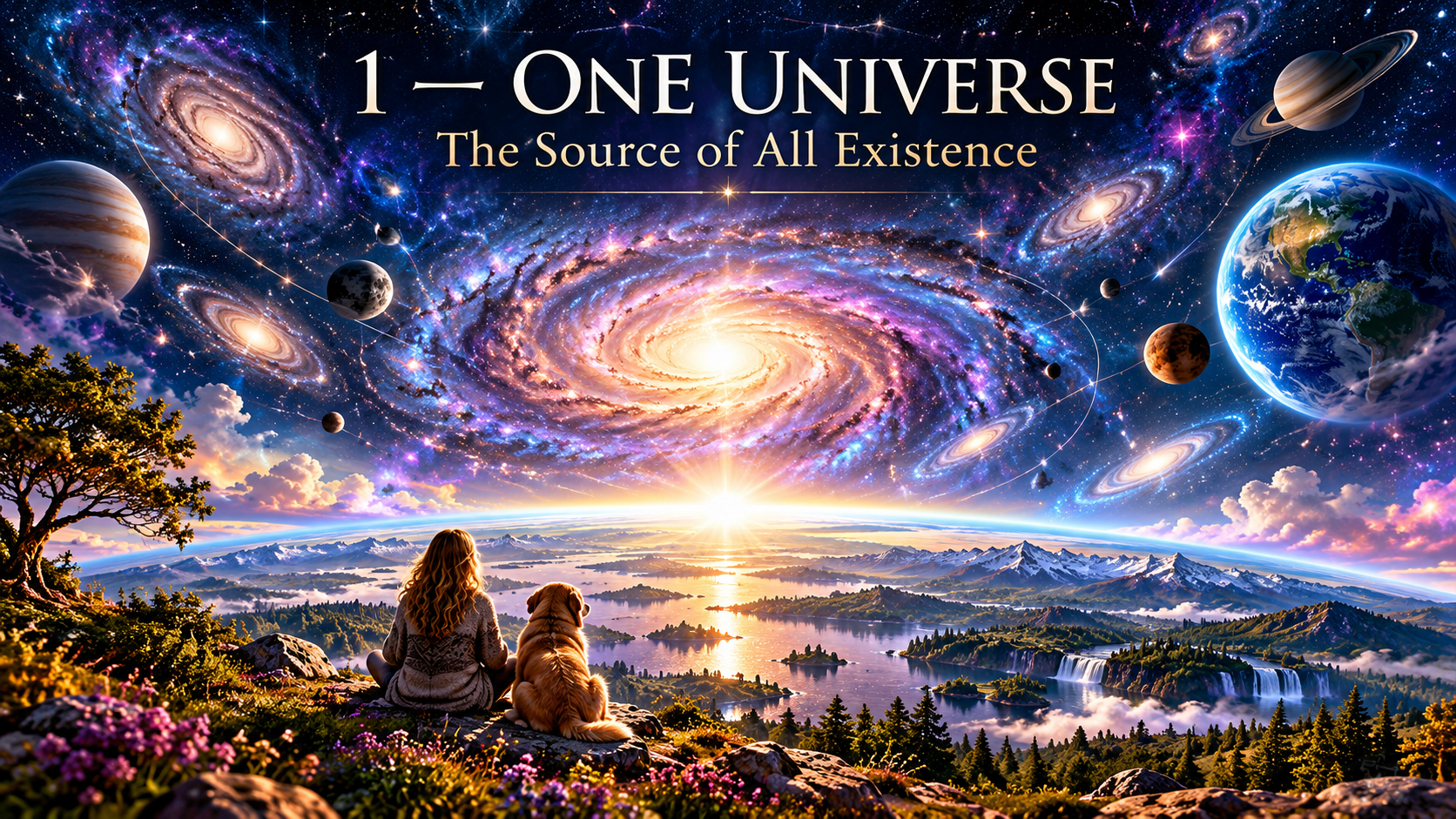
The Twelve Numbers of Creation — Number One
Principle: One Universe | Concept: The Source | Theme: Unity and the Origins of Existence
Before we can begin to understand the many forms of existence, we must first consider the greater whole to which they belong. From the smallest particles to the largest galaxies, everything we observe exists within one extraordinary Universe. But what does it truly mean to be part of this greater whole?
The Beginning of Everything
Look up at the night sky.
Beyond the familiar stars lies an extraordinary expanse of galaxies, celestial bodies, radiation, matter and regions of space that extend far beyond our everyday experience.
Somewhere within this immense cosmic landscape exists a relatively small planet orbiting an ordinary star.
That planet is Earth.
And here, surrounded by an extraordinary diversity of living organisms, we have developed the ability to observe, question and contemplate the Universe in which we exist.
We look towards the stars and wonder where everything came from.
We examine the natural world and seek to understand how it functions.
We explore our own minds and ask why we are capable of experiencing existence at all.
These questions have inspired scientific discoveries, philosophical discussions and spiritual traditions throughout human history.
Yet beneath their different approaches lies a shared curiosity:
What is the nature of the reality to which we all belong?

Within my philosophical framework, The Twelve Numbers of Creation, I begin with one fundamental principle:
One Universe.
Before exploring consciousness, energy, matter or the human journey, I invite us to consider existence as one interconnected whole.
Every particle, every star, every planet and every living being belongs to the same physical reality.
Although we experience the world through individual perspectives, our existence is inseparable from the Universe that surrounds and sustains us.
To understand ourselves, we must first recognise the greater whole of which we are a part.
What Do We Mean by One Universe?
The word Universe refers to the totality of physical existence, including space, time, matter, energy and the processes through which they interact.
From a scientific perspective, the observable Universe encompasses everything from which light or other information has had sufficient time to reach us.
Its vastness is difficult to comprehend.
Galaxies contain enormous numbers of stars.
Many stars are surrounded by planets and other celestial objects.
Matter exists in countless arrangements, from diffuse interstellar gas to complex biological structures.
Yet despite this extraordinary diversity, the physical world is governed by consistent underlying principles.
Gravity influences the motion of celestial bodies.
Electromagnetic interactions contribute to the behaviour of atoms and molecules.
The fundamental interactions described by physics help explain how matter behaves across different environments.
The same chemical elements found throughout the cosmos are present within our planet and our bodies.
This consistency provides a remarkable foundation for understanding our place in existence.
We are not observing an entirely different reality when we study distant galaxies. We are investigating another part of the same physical Universe to which we belong.
Within my philosophy, this shared reality represents the first expression of Oneness.
It reminds us that separation is often a matter of perspective and scale.
We may distinguish between objects, organisms and environments, yet these distinctions exist within a larger system of relationships.
The Universe is not simply a collection of unrelated parts.
It is a physical reality in which interactions and connections help shape the structures we observe.
The Source: Where Did Everything Come From?
One of humanity’s oldest questions concerns the origin of existence.
Where did the Universe come from?
Why does anything exist at all?
Was there a beginning?
And if there was, what made that beginning possible?
Scientific cosmology has provided remarkable insights into the early development of the observable Universe.
The Big Bang model describes the expansion of the Universe from an extremely hot, dense early state approximately 13.8 billion years ago.
Evidence supporting this model includes the expansion of space, the cosmic microwave background radiation and the observed abundance of light elements.
Over time, the expanding Universe cooled, allowing particles, atoms, stars and galaxies to form.
Within stars and other astrophysical processes, heavier chemical elements were produced and dispersed into space.
Some of these materials eventually became part of planets, including Earth.
And on Earth, under conditions that remain the subject of ongoing scientific investigation, life emerged.
This account provides an extraordinary explanation of cosmic evolution.
However, it does not necessarily answer every philosophical question about existence.
The Big Bang model does not establish why the Universe exists, whether there was an absolute beginning of everything, or whether anything preceded the earliest state described by our current theories.
These questions remain open to scientific investigation and philosophical interpretation.
Within my Conscious Energy philosophy, I use the term the Source to represent the possibility of an underlying origin or unity from which the many expressions of existence arise.
The Source is not a scientifically identified substance or location.
Rather, it is a philosophical concept through which I explore the relationship between the Universe and everything contained within it.
If the Universe is the greater whole, the Source represents my attempt to contemplate the underlying unity from which its many forms emerge.
Could the Universe Have Experienced an Awakening?
One possibility that fascinates me is the idea of a universal awakening.
What if the emergence of the Universe could be imagined as a transition from potential into expression?
What if the beginning of cosmic evolution symbolised a moment when existence began unfolding into increasingly complex forms?
And what if consciousness, rather than being entirely separate from this story, represents one of the ways the Universe eventually becomes capable of experiencing itself?
Within my philosophical framework, I sometimes imagine the early Universe as a state of immense potential.
Through the development of physical structures, increasingly complex systems emerged.
Stars formed.
Planets developed.
Chemical interactions produced new arrangements of matter.
Eventually, at least on Earth, living organisms arose.
Over immense periods of evolutionary history, some organisms developed nervous systems capable of processing information, responding to their environments and supporting conscious experience.
Human beings eventually developed the ability to reflect upon their own existence and investigate the wider Universe.
From this perspective, cosmic evolution has produced beings capable of contemplating the very processes from which they emerged.
I find this deeply meaningful.
It raises the possibility of viewing consciousness as part of the Universe’s unfolding story.
However, the suggestion that the Big Bang represented a literal awakening of a universal consciousness is a philosophical or spiritual hypothesis, not an established scientific explanation.
Current cosmology does not demonstrate that the early Universe possessed awareness, intention or a desire to create.
Nevertheless, the metaphor invites a profound reflection:
Perhaps the Universe has not only produced extraordinary physical structures, but has also given rise to beings capable of looking back upon their origins and asking what existence means.
In that sense, we might poetically describe ourselves as the Universe becoming aware of itself.

One Universe, Many Expressions
Although we describe the Universe as one whole, its diversity is extraordinary.
Consider the difference between a star and a tree.
A star is an immense physical system sustained by gravitational forces and nuclear reactions.
A tree is a living organism that uses sunlight, water, carbon dioxide and nutrients to grow and maintain its biological functions.
Their structures and processes differ enormously.
Yet both exist within the same physical reality.
Both depend upon interactions between matter and energy.
Both participate in natural processes governed by the laws of physics.
Now consider the human body.
Our bodies are composed of atoms and molecules arranged into cells, tissues, organs and biological systems.
These systems interact to maintain the conditions necessary for life.
Our brains support perception, memory, thought and conscious experience.
Through our senses, we become aware of the environments in which we exist.
Through movement and communication, we participate in the world around us.
From the perspective of my framework, these different forms of existence demonstrate an important principle:
Unity does not require uniformity.
The Universe can contain extraordinary diversity while remaining one interconnected reality.
Every form of matter has its own structure.
Every living organism follows its own biological processes.
Every conscious individual experiences the world through a unique perspective.
Yet none exists entirely independently of the greater whole.
The Fabric of Reality: A Universe of Relationships
When we observe the physical world, we tend to identify separate objects.
A mountain.
A river.
A tree.
A human being.
A distant planet.
These distinctions help us understand and navigate our surroundings.
Yet a deeper examination reveals that the existence and behaviour of physical systems depend upon relationships and interactions.
A river is shaped by gravity, rainfall, geography and the movement of water.
A forest depends upon relationships between plants, animals, microorganisms, soil, sunlight and climate.
A human body depends upon interactions between biological systems and its surrounding environment.
Even celestial structures are shaped by gravitational and other physical processes.
Within my philosophy, I use the expression the fabric of reality to describe this interconnected network of existence.
It represents the idea that the Universe is not merely a collection of isolated objects.
It is a continuously evolving physical reality in which relationships help determine what emerges and how systems behave.
This does not mean every object is directly connected to every other object in a meaningful or conscious way.
Rather, it recognises that physical existence unfolds through interactions occurring across many different scales.
The concept also encourages us to consider our own participation in these relationships.
The air we breathe connects us to the atmosphere.
The food we consume connects us to ecosystems.
Our relationships connect us to other people.
Our actions influence the environments and communities in which we live.
We do not simply exist within the Universe as passive observers. We participate in the processes through which our lives unfold.
The Universe and the Search for an Underlying Formula
Throughout scientific history, researchers have sought to understand whether the complexity of nature can be explained through a smaller number of fundamental principles.
Physics has identified mathematical relationships that describe many aspects of the natural world.
These relationships help explain the behaviour of matter, energy, forces and physical systems.
However, our scientific understanding remains incomplete.
Questions surrounding quantum gravity, dark matter, dark energy and the nature of consciousness continue to inspire investigation.
Within my own philosophy, I explore the possibility that certain recurring relationships might offer a broader conceptual way of understanding existence.
I am particularly interested in the relationship between opposing yet complementary qualities.
Stillness and movement.
Stability and transformation.
Observation and action.
Potential and expression.
These relationships inspired my development of the Conscious Energy framework.
I do not present Conscious Energy as a scientifically verified formula governing the Universe.
Instead, I use it as an interpretive model through which I explore patterns of balance, interaction and change.
The purpose is not to replace established physics.
It is to encourage philosophical reflection upon how different aspects of existence relate to one another.
Perhaps understanding the Universe begins not only with examining its individual components, but also with exploring the relationships between them.
Consciousness and Energy: The Next Layer of Creation
Having established the Universe as one greater whole, the next stage of my framework introduces two complementary principles:
Consciousness and Energy.
Within Conscious Energy, I associate Consciousness with awareness, observation, information, reflection and stillness.
I associate Energy with movement, activity, expression and transformation.
These qualities provide a symbolic way of exploring the relationship between stability and change.
In everyday life, we can recognise similar patterns.
We observe before responding.
We reflect before making decisions.
We alternate between rest and activity.
We balance the need for security with the desire to explore.
In the natural world, physical systems also exhibit different forms of stability, movement and transformation.
However, these similarities do not establish that consciousness and energy are literally two opposing physical forces.
Scientific energy is a measurable property, while consciousness refers to subjective awareness and related cognitive phenomena.
Within my philosophy, their relationship is therefore conceptual rather than a demonstrated physical equivalence.
I use these principles to ask whether complementary qualities might provide a useful perspective for understanding the relationship between existence and experience.
This brings us to Number Two of the Twelve Numbers of Creation:
Two Forces — Consciousness and Energy.
But before exploring their relationship, it is important to recognise that both concepts are being considered within the greater context established by Number One.
One Universe provides the foundation. Consciousness and Energy introduce the complementary principles through which I begin exploring its many expressions.

The Universe Within Us
One of the most extraordinary aspects of human existence is that our bodies are composed of materials originating from cosmic processes.
The hydrogen present in the Universe largely traces back to its earliest history.
Many heavier elements essential to life were formed through stellar processes and other astrophysical events.
The carbon, oxygen, calcium and iron found within our bodies are part of this wider cosmic history.
We are therefore connected to the Universe not merely through philosophical interpretation, but through the physical origins of the matter that forms us.
Our bodies are temporary arrangements of materials that have participated in natural processes for billions of years.
Yet through these arrangements, we experience something remarkable.
We perceive.
We remember.
We imagine.
We communicate.
We develop relationships.
We question our own existence.
Within my philosophy, I find it meaningful to imagine the human body as a meeting place between physical reality and conscious experience.
Our senses allow us to observe the world.
Our biological systems support the activities necessary for life.
Our minds interpret experiences and contribute to our understanding of ourselves.
This leads me to an important reflection:
The Universe is not only something we observe beyond ourselves. It is also the physical reality from which our own existence has emerged.
Science, Spirituality and the Question of Creation
The question of the Universe’s origin has inspired many different explanations.
Science investigates natural phenomena through observation, experimentation, mathematical modelling and evidence.
Religious traditions may interpret existence through the actions or intentions of a creator.
Spiritual philosophies may explore concepts such as universal consciousness, divine unity or an underlying source of existence.
These approaches do not always provide compatible explanations.
They may differ significantly in their assumptions, methods and conclusions.
Nevertheless, they can encourage meaningful discussions about questions that matter deeply to humanity.
Science can investigate how the Universe developed from its early physical conditions.
Philosophy can examine questions about existence, causation and meaning.
Spirituality can provide individuals with personal frameworks for understanding purpose, belonging and transcendence.
Within The Earth & Body Connection, I am interested in exploring the spaces where these different perspectives meet.
I do not believe we need to dismiss scientific discoveries in order to contemplate spiritual possibilities.
Nor should spiritual beliefs be presented as established scientific facts without supporting evidence.
Instead, we can remain curious about what is known, what remains uncertain and what different interpretations may contribute to our understanding.
Perhaps the search for truth is enriched when curiosity is accompanied by both imagination and critical thinking.
The Meaning of Oneness in Everyday Life
Although the first number of creation explores the Universe on an immense scale, its meaning can also be considered through everyday experience.
Recognising our place within a shared world may encourage us to reconsider how we relate to ourselves, other people and nature.
We depend upon ecosystems for food, water and the conditions necessary for life.
We rely upon communities for knowledge, cooperation and support.
Our individual wellbeing is influenced by the environments and relationships that surround us.
This interconnectedness carries practical implications.
We can choose to care for the natural world.
We can recognise the dignity of people whose experiences differ from our own.
We can develop greater awareness of how our choices affect others.
We can appreciate the extraordinary circumstances that make life possible.
Within my philosophy, these practices represent ways of expressing Oneness.
They remind us that individuality and belonging are not mutually exclusive.
We can celebrate our differences while recognising our shared humanity.
We can pursue personal goals while contributing to the wellbeing of others.
We can appreciate our unique experiences without forgetting the greater world that sustains them.
To recognise Oneness is not to lose ourselves within the Universe, but to understand that our individuality exists within it.
From the Outer Universe to the Inner Universe
The Twelve Numbers of Creation explores two interconnected dimensions of existence.
The first five numbers introduce the foundations of our experience of the external world.
1 — One Universe
The greater whole within which existence unfolds.
2 — Two Forces
Consciousness and Energy, understood as complementary principles within my philosophy.
3 — Three Aspects of Being
Mind, Body and Spirit — symbolic dimensions of human experience.
4 — Four Elements
Air, Water, Earth and Fire — traditional symbols representing qualities and processes within nature.
5 — Five Senses
Sight, hearing, smell, taste and touch — familiar pathways through which we perceive the world, alongside other sensory systems recognised by biology.
The following seven numbers form the Rainbow Bridge of Life, exploring our personal journey through the world.
6 — Survival (Red): To Have
7 — Creativity (Orange): To Do
8 — Identity (Yellow): To Show
9 — Relationships (Green): To Serve
10 — Connectedness (Blue): To Support
11 — Guidance (Indigo): To Teach
12 — Release (Violet): To Let Go
And beyond the twelve lies the final symbolic expression:
13 — Oneness (White): To Be
The framework begins with unity, explores the diversity of existence and eventually returns to the concept of Oneness.
This progression is not intended as a literal scientific sequence through which the Universe developed.
It is a philosophical structure designed to encourage reflection upon the relationships between physical existence, personal experience and our place within the greater whole.
We begin with One Universe, explore its many expressions and return to the recognition that we have belonged to the same greater whole all along.
A Personal Reflection: Recognising Our Place in the Universe
Take a moment to consider your relationship with the Universe and the natural world.
You might reflect upon the following questions:
- When I look at the night sky, what thoughts or feelings arise about my place in existence?
- What does the concept of a shared source mean to me personally?
- How has my understanding of the Universe changed throughout my life?
- Do I view myself primarily as an individual, or do I also recognise my connection to a greater whole?
- What aspects of nature remind me of the relationships that sustain life?
- How might recognising our shared physical origins influence the way I treat others?
- What questions about the Universe remain most meaningful to me?
- How can I express a greater sense of connection through my everyday choices?
There are no right or wrong answers.
Our understanding of existence is shaped by scientific knowledge, personal experience, cultural traditions and spiritual beliefs.
The purpose of these questions is not to establish one universal interpretation.
It is to encourage curiosity about the extraordinary reality in which we participate.
Perhaps the most meaningful question is:
What if understanding our place in the Universe begins with recognising that we have never existed independently of it?

The Wisdom of One: The Source of Our Shared Existence
The first number of creation invites us to contemplate the Universe as one extraordinary whole.
Before we examine the complexity of matter, the nature of consciousness or the journey of human life, we begin by recognising the shared reality to which everything belongs.
The Universe contains an immense diversity of physical structures and processes.
Stars illuminate distant galaxies.
Planets orbit their suns.
Living organisms develop within environments that support their existence.
And here on Earth, human beings have developed the capacity to contemplate the very Universe from which they emerged.
Within my philosophy, I interpret this as an expression of unity within diversity.
We are individuals, yet we share a common physical origin.
We experience the world through unique perspectives, yet we depend upon the same natural reality.
We participate in different relationships and environments, yet our lives remain connected through the greater processes of existence.
I call this greater unity the Source.
Not as a scientifically established universal consciousness, but as a philosophical invitation to contemplate the underlying reality from which the many expressions of existence emerge.
The concept encourages us to recognise that our lives are not separate from the story of the Universe.
We are participants within it.
Our bodies belong to its physical processes.
Our experiences contribute to the unfolding story of life on Earth.
And through our capacity for awareness, we can contemplate the extraordinary circumstances that make our existence possible.
One Universe is the foundation of the Twelve Numbers of Creation.
Unity is its central principle.
The Source represents the greater whole.
And from this foundation, we begin exploring the complementary qualities that inspire the next stage of my framework:
Consciousness and Energy.
Because perhaps the greatest mystery is not simply how the Universe came into existence.
Perhaps it is how, within this immense physical reality, life emerged with the capacity to wonder about its own origins.
One Universe. One Shared Reality. Countless Expressions of Existence.
This article forms part of The Twelve Numbers of Creation, an original philosophical framework developed through The Earth & Body Connection. Scientific concepts are discussed alongside philosophical and spiritual interpretations. The Source, universal awakening and Conscious Energy are conceptual or speculative elements of this framework, not established scientific explanations of cosmology or consciousness. The Big Bang model describes the early expansion and evolution of the observable Universe; it does not establish that the Universe began through an act of conscious awareness.
Next in the series: Two Forces — Consciousness and Energy.
Leave a Reply