
The Twelve Numbers of Creation — Number Three
Principle: Three Aspects of Being | Concepts: Mind, Body and Spirit | Theme: Wisdom, Beauty and Love
What if understanding ourselves begins with recognising three interconnected aspects of our existence — the mind through which we develop awareness, the body through which we experience the physical world, and the spirit through which we discover meaning, motivation and connection?
From Two Forces to Three Aspects of Being
Our journey through the Twelve Numbers of Creation began with one fundamental principle:
One Universe.
We explored the idea that everything we observe belongs to one extraordinary physical reality — a greater whole containing the foundations of existence.
We then introduced the second principle:
Two Forces — Consciousness and Energy.
Within my philosophical framework, Consciousness represents the qualities of awareness, observation, reflection and understanding, while Energy represents movement, activity, expression and transformation.
These complementary principles provide a symbolic way of exploring the relationship between knowing and doing, stillness and movement, and potential and expression.
Now, we arrive at the third number of creation.

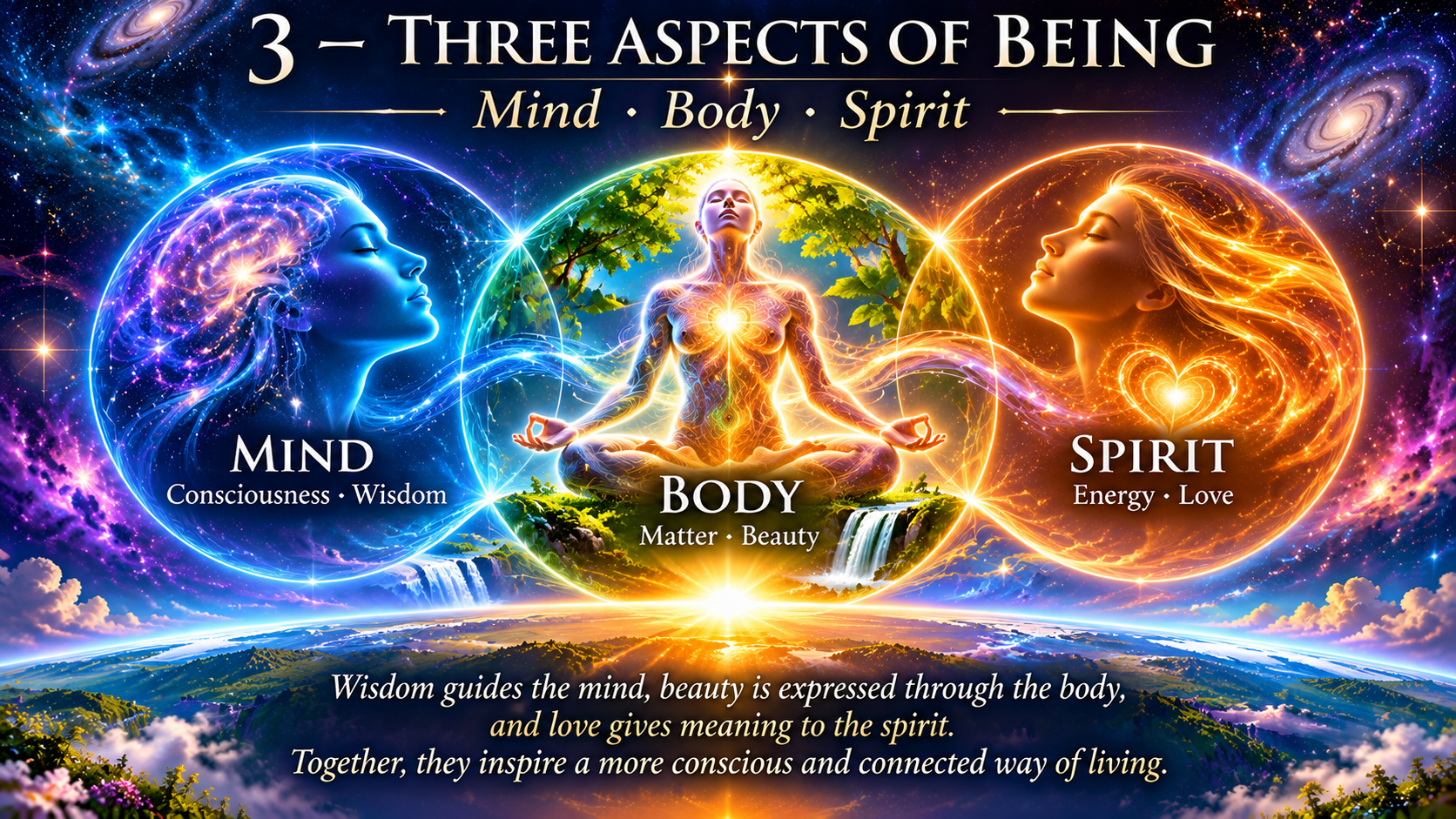
Three Aspects of Being — Mind, Body and Spirit.
Here, the framework moves from the broader principles of existence towards the individual experience of life.
We begin to consider how awareness, physical existence and meaningful expression relate to one another.
Within my Conscious Energy philosophy, I associate these three aspects with three fundamental concepts:
- Mind — Consciousness — Wisdom
- Body — Matter — Beauty
- Spirit — Energy — Love
Together, these relationships provide a foundation for exploring what it means to be a conscious, living participant within the Universe.
The Mind allows us to interpret our experiences.
The Body provides the physical structure through which those experiences occur.
The Spirit represents the meaning, motivation and connection we discover through living.
Although these aspects can be considered individually, they are deeply interconnected within our everyday experience.
To understand ourselves more completely, we must consider not only what we think, what we do or what we feel, but how these dimensions influence one another.
The Mind: Consciousness and the Pursuit of Wisdom
The first aspect of our being is the Mind.
Within my framework, the Mind represents Consciousness — the capacity to observe, interpret, remember, imagine and reflect upon existence.
Our minds allow us to develop an understanding of the world around us.
Through sensory perception, we receive information from our environment.
Through memory, we connect present experiences with events from the past.
Through reasoning and imagination, we consider possibilities that extend beyond our immediate surroundings.
And through self-awareness, we begin to recognise ourselves as individuals with unique thoughts, emotions and perspectives.
Consider the simple experience of watching a sunrise.
Your eyes detect the changing light.
Your brain processes visual information, allowing you to recognise colours, shapes and movement.
Memories may influence how you interpret the experience.
Perhaps the sunrise reminds you of a peaceful childhood memory, a meaningful journey or a moment of personal transformation.
Although another person may observe the same sunrise, their experience may differ from yours.
This illustrates an important characteristic of consciousness:
We share a physical world, yet experience it through individual perspectives.
Wisdom: The Higher Expression of Mind
Within my philosophy, I associate the Mind with Wisdom.
Wisdom is more than the accumulation of information.
It involves developing understanding through experience, reflection and thoughtful judgement.
Knowledge may help us recognise how something works.
Wisdom helps us consider when, why and how that knowledge should be applied.
We may learn that our words can influence another person’s emotions.
Wisdom encourages us to consider the consequences of what we say.
We may understand that our bodies require rest.
Wisdom helps us recognise when continuing to push ourselves may be unhelpful.
We may possess strong opinions about the world.
Wisdom encourages us to remain open to perspectives that challenge our assumptions.
Throughout life, our understanding changes as we encounter new information and experiences.
We learn from successes.
We learn from mistakes.
We develop greater awareness of our strengths and limitations.
And we gradually discover that understanding ourselves also requires recognising how our thoughts influence our relationships and behaviour.
Within the Rainbow Bridge of Life, wisdom becomes especially significant during the Indigo stage of Guidance — To Teach.
However, wisdom is not reserved for old age.
It can be developed throughout our lives whenever we approach experience with curiosity, humility and a willingness to learn.
The Mind allows us to know. Wisdom teaches us how to use what we know.
The Body: Matter and the Expression of Beauty
The second aspect of our being is the Body.
Within my framework, the Body represents Matter — the physical expression of existence.
Our bodies are composed of atoms and molecules arranged into complex biological systems.
These systems work together to support the processes necessary for life.
Our hearts circulate blood.
Our lungs participate in gas exchange.
Our digestive systems process nutrients.
Our muscles and skeletons support movement.
Our nervous systems coordinate sensory information, behaviour and numerous internal functions.
Through these interconnected processes, we experience the world as living organisms.
Our bodies allow us to see, hear, smell, taste and touch.
They also provide additional sensory capabilities, including awareness of balance, body position, temperature, pain and internal bodily conditions.
The body is therefore much more than a physical container.
It is an active, living system through which perception, thought, emotion and behaviour become possible.
Within my philosophy, I describe the body as the meeting place between Consciousness and Energy.
This is a symbolic relationship rather than a scientifically established separation between two physical forces.
The body does not merely receive instructions from an independent mind or spirit.
Instead, our mental experiences and physical processes are closely related through the functioning of the brain, nervous system and wider body.
Our bodies provide the physical foundation through which we participate in the extraordinary experience of life.
Beauty: The Higher Expression of Body
Within my framework, I associate the Body with Beauty.
However, beauty extends far beyond physical appearance.
It exists in the remarkable organisation of natural systems.
In the intricate patterns of a leaf.
In the structure of a snowflake.
In the movement of water through a river.
In the colours of a sunset.
In the extraordinary diversity of living organisms.
Beauty can also be recognised in the human body through its capacity for movement, adaptation, healing and expression.
A person’s beauty is not determined by their age, shape, physical ability or resemblance to cultural ideals.
Instead, we can appreciate the body as a living expression of nature, shaped by biological development, individual experience and environmental influences.
Consider the human hand.
It can hold a newborn child.
Plant a seed.
Prepare a meal.
Create a painting.
Offer comfort.
Or reach towards another person in friendship.
The same physical structure can participate in countless meaningful experiences.
Beauty therefore emerges not only from what the body looks like, but also from what it allows us to experience and contribute.
Within the Rainbow Bridge of Life, this appreciation becomes especially meaningful during the Blue stage of Connectedness — To Support.
At this stage, we explore our relationship with the wider world and the beauty that emerges through care, cooperation and connection.
Yet the appreciation of beauty is available throughout life.
The Body allows us to experience the physical world. Beauty invites us to recognise its extraordinary value.
The Spirit: Energy and the Expression of Love
The third aspect of our being is the Spirit.
Within my philosophical framework, I associate Spirit with Energy.
I use Spirit to represent the motivating and expressive qualities of our existence — the desire to explore, create, connect and participate in life.
Throughout history, spiritual traditions have interpreted the concept of spirit in many different ways.
Some understand it as an immortal soul.
Others associate it with life force, divine connection or an underlying essence of being.
In my framework, Spirit provides a philosophical language for exploring meaning, motivation and the qualities that inspire us to act.
It is important to distinguish this interpretation from energy as defined in physics.
Physical energy is measurable and involved in processes such as movement, metabolism and heat transfer.
A spiritual life force or soul has not been established as a distinct measurable form of physical energy.
Nevertheless, the concept of Spirit can offer a meaningful way of reflecting upon our experiences.
Consider the feeling of inspiration.
You may become deeply interested in an idea.
You imagine what could be possible.
You feel motivated to create something meaningful.
You begin taking practical steps towards bringing that idea into reality.
Within my framework, Spirit symbolises the motivation and expressive quality of this experience.
It represents the movement from inner meaning towards outward participation.
The Spirit invites us to consider not only how we live, but what gives our lives meaning.
Love: The Higher Expression of Spirit
Within my philosophy, I associate Spirit with Love.
Love is one of the most meaningful aspects of human experience.
It influences our relationships, strengthens social bonds and motivates acts of care and cooperation.
Love can be expressed through affection, compassion, patience, responsibility and generosity.
It can be directed towards romantic partners, family members, friends, animals, communities and the natural world.
Love also includes the relationship we develop with ourselves.
Learning to respect our needs, recognise our limitations and treat ourselves with compassion can influence how we participate in relationships with others.
Within the Rainbow Bridge of Life, Love is central to the Green stage of Relationships — To Serve.
This stage encourages us to move beyond an exclusive focus on our individual needs and consider how our actions contribute to the wellbeing of others.
However, love does not require us to abandon our individuality or sacrifice our wellbeing without limits.
Healthy relationships involve respect, communication, boundaries and mutual consideration.
Love is not measured solely by how much we give.
It is also expressed through our willingness to recognise the dignity and needs of everyone involved, including ourselves.
Within my philosophy, Love represents the qualities that encourage us to move beyond isolation and participate meaningfully in the lives of others.
The Spirit inspires us to connect. Love gives that connection meaning.
Wisdom, Beauty and Love: Three Expressions of One Existence
Having explored the Mind, Body and Spirit individually, we can begin to consider how these aspects relate to one another.
Within my framework, Wisdom, Beauty and Love represent three complementary expressions of a meaningful life.
| Aspect | Philosophical principle | Core value |
| Mind | Consciousness | Wisdom |
| Body | Matter | Beauty |
| Spirit | Energy | Love |
Each value contributes something different to our experience.
Wisdom encourages understanding.
Beauty inspires appreciation.
Love motivates connection.
Together, they provide a philosophical foundation for living with greater awareness and purpose.
Imagine creating a community garden.
Wisdom helps us understand the needs of the plants, the environment and the people involved.
Beauty emerges through the physical expression of the garden — its colours, textures, growth and relationship with the surrounding landscape.
Love inspires the care, cooperation and commitment required to nurture the garden over time.
The result is more than a collection of plants.
It becomes a place where knowledge, nature and human connection contribute to a shared experience.
This example illustrates how the three principles can complement one another.
Wisdom without compassion may become detached from human needs.
Love without understanding may lead to unintended consequences.
An appreciation of beauty without responsibility may overlook the conditions necessary to preserve it.
Yet when these values are considered together, they can support more thoughtful and meaningful choices.
Wisdom helps us understand life. Beauty encourages us to appreciate it. Love inspires us to care for it.
The Body as the Meeting Place Between Consciousness and Energy
One of the central ideas within my Conscious Energy philosophy is that the body represents the physical meeting place between Consciousness and Energy.
I use this relationship to explore how awareness and activity become part of our lived experience.
Consider the process of learning to play a musical instrument.
At first, we observe the instrument and begin understanding how it works.
We listen to sounds, recognise patterns and develop knowledge of the movements required.
Our minds contribute attention, memory and learning.
Our bodies perform the necessary movements.
Physical energy supports the activity of our muscles, nervous system and other biological processes.
Over time, repeated practice allows us to develop new skills.
Eventually, the instrument becomes a means of creative expression.
The experience involves awareness, physical activity and personal meaning.
Within my framework, these relationships can be represented symbolically as:
Consciousness (Mind) — Matter (Body) — Energy (Spirit)
However, the sequence should not be interpreted as a literal scientific mechanism through which consciousness and spiritual energy combine to create matter.
Rather, it illustrates three perspectives through which we can consider human experience.
The Mind represents our capacity for awareness and understanding.
The Body represents our physical existence.
The Spirit represents our sense of motivation, meaning and expression.
The body connects our inner experiences with the world in which we live.
Are We a Reflection of Our Thoughts and Actions?
An important part of my philosophy is the idea that our lives are influenced by the relationship between our thoughts, actions and experiences.
The choices we make can shape our habits.
Our habits can influence our behaviour.
Our behaviour can affect our relationships, environments and wellbeing.
Over time, these patterns may contribute to the direction of our lives.
For example, someone who develops a regular practice of physical activity may experience changes in fitness, confidence and daily routine.
Someone who spends time learning a new skill may develop greater knowledge and capability.
Someone who prioritises supportive relationships may create opportunities for stronger social connections.
These examples illustrate how repeated experiences and actions can contribute to personal development.
However, it is important to recognise that our physical condition and life circumstances are not simply reflections of our thoughts or personal choices.
Genetics, illness, disability, ageing, socioeconomic conditions, environmental influences and events beyond our control can significantly affect our lives.
We cannot assume that someone’s appearance, health or circumstances reveal the quality of their consciousness, spirit or personal character.
Within my framework, the relationship between thought and action is therefore best understood as an invitation to recognise where we have influence, rather than a claim that we control every aspect of our existence.
We may not choose every circumstance we encounter, but we can develop greater awareness of how we respond to the circumstances within our influence.
Finding Harmony Between Mind, Body and Spirit
Harmony is a central theme throughout The Earth & Body Connection.
Within my philosophy, harmony represents a relationship in which different aspects of our lives support one another.
It does not mean maintaining a perfect state of happiness, health or emotional stability.
Nor does it require us to eliminate difficult thoughts, uncomfortable emotions or periods of uncertainty.
Life naturally involves change.
Our needs evolve.
Our circumstances shift.
Our bodies adapt.
Our understanding develops.
Harmony therefore requires flexibility rather than perfection.
Caring for the Mind
We can support our mental wellbeing by creating opportunities for learning, reflection and meaningful engagement.
Reading, problem-solving, creative activities, social connection and mindfulness practices may provide opportunities to develop awareness.
Seeking appropriate support during periods of emotional difficulty is equally important.
The pursuit of wisdom begins with recognising that we do not need to understand everything.
Caring for the Body
Our physical wellbeing depends upon many interacting factors.
Adequate nutrition, hydration, sleep, movement, hygiene and access to healthcare can contribute to maintaining health.
Our individual needs differ according to age, health, ability and circumstances.
Caring for the body involves recognising these differences and responding with respect rather than judgement.
The appreciation of beauty begins with recognising the value of the physical existence that allows us to experience life.
Nurturing the Spirit
Within my philosophy, nurturing the Spirit means creating space for meaning, connection and personal expression.
This may involve spending time in nature, developing relationships, practising gratitude, engaging in creative activities or contributing to something beyond our immediate interests.
For some people, spiritual practices or religious beliefs provide an important source of meaning.
For others, purpose may be found through family, community, learning, creativity or service.
There is no single experience that defines a meaningful life for everyone.
The expression of love begins with recognising what matters to us and how we wish to participate in the world.
Harmony emerges when we learn to respond to the needs of our minds, bodies and personal sense of meaning with awareness and care.
The Three Aspects of Being in Nature
Although Mind, Body and Spirit are most commonly discussed in relation to human experience, my framework also invites us to contemplate similar symbolic relationships throughout the natural world.
Consider a tree.
Its physical structure consists of roots, trunk, branches, leaves and complex biological tissues.
These structures allow it to absorb water and nutrients, capture sunlight and participate in ecological relationships.
Its growth depends upon numerous physical and chemical processes.
The tree also responds to environmental information, including changes in light, temperature, moisture and chemical signals.
These responses demonstrate sophisticated biological regulation, although they do not establish that the tree possesses conscious experience comparable to that of a human being.
Within my philosophical framework, I use the tree as a symbolic illustration of the three aspects.
Mind represents the reception and processing of information.
Body represents the tree’s physical structure.
Spirit represents the activity and transformation involved in its growth and participation within the ecosystem.
This analogy does not mean that all living organisms possess human-like minds or spiritual identities.
Rather, it encourages us to recognise recurring relationships between physical structure, information and activity.
The tree also expresses Wisdom, Beauty and Love in a symbolic sense.
Wisdom may be represented through the remarkable adaptations that allow it to survive.
Beauty emerges through its physical form and relationship with the landscape.
Love can be understood through the care and appreciation that humans extend towards the natural world.
Nature reminds us that life unfolds through relationships between physical structures, environmental conditions and ongoing processes of change.
The Three Aspects and Our Connection to the Universe
Within the first principle of the Twelve Numbers of Creation, we explored the Universe as one interconnected whole.
The second principle introduced Consciousness and Energy as complementary qualities within my philosophical model.
The third principle brings these ideas into the context of human existence.
We possess physical bodies composed of materials that originate from the wider Universe.
Our biological systems depend upon interactions with the environment.
Our minds allow us to develop awareness of ourselves and our surroundings.
And through our experiences, relationships and actions, we develop personal interpretations of meaning and purpose.
Within my philosophy, this relationship encourages a deeper appreciation of our place in existence.
We are not independent of the natural world.
We depend upon it.
The food we eat, the air we breathe and the materials that form our bodies all connect us to the physical processes of the Earth and the wider cosmos.
Our relationships also connect us to other living beings.
Through cooperation, communication and care, we participate in the social and ecological systems that support life.
I use the concept of collective consciousness to reflect upon this shared dimension of human experience.
In this context, collective consciousness refers to the ways knowledge, values, memories and cultural understanding can be developed and shared across communities and generations.
The stronger metaphysical idea of a single universal mind connecting all beings remains a philosophical or spiritual proposition rather than an established scientific finding.
Nevertheless, recognising our shared physical origins and social connections can encourage a meaningful sense of belonging.
We are individual expressions of life, yet our existence remains inseparable from the greater world that sustains us.
Authenticity: When Mind, Body and Spirit Work Together
One of the most meaningful applications of the Three Aspects of Being is the pursuit of authenticity.
Authenticity involves developing a relationship between our understanding of ourselves, our values and the choices we make.
It encourages us to consider whether the life we are living reflects what genuinely matters to us.
Our Mind helps us recognise our beliefs, aspirations and personal needs.
Our Body allows us to participate in the world through practical actions.
Our Spirit represents the meaning and motivation that inspire those actions.
When these dimensions are considered together, we may develop a clearer understanding of our personal direction.
For example, someone may value compassion but find that their daily responsibilities leave little time for meaningful relationships.
Another person may recognise the importance of physical wellbeing but struggle to establish routines that support their needs.
Someone else may have creative aspirations but feel uncertain about expressing their individuality.
These experiences do not indicate personal failure.
They simply reveal areas where our intentions, circumstances and actions may not yet be aligned.
Within my philosophy, authenticity involves recognising these differences and considering what changes are possible.
Sometimes that means taking action.
Sometimes it means accepting limitations.
And sometimes it means reconsidering expectations that no longer reflect who we are becoming.
Authenticity is not about creating a perfect life. It is about developing a more conscious relationship with the life we are living.
From Three Aspects to Four Elements
Having explored Mind, Body and Spirit, we can begin considering how these symbolic dimensions relate to the natural world.
The next principle of the Twelve Numbers of Creation introduces:
Four Elements — Air, Water, Earth and Fire.
Throughout history, these elements have been used in philosophical and spiritual traditions to represent different qualities of nature.
Air may symbolise movement, breath and communication.
Water may represent flow, adaptation and renewal.
Earth may represent structure, stability and nourishment.
Fire may represent transformation, warmth and activity.
These traditional elements are not the four scientific states of matter, which are commonly identified as solid, liquid, gas and plasma.
Instead, they provide a symbolic language for exploring the natural processes that shape our environment and our experiences.
Within my framework, the Four Elements form the next stage in our journey from the greater Universe towards the physical world we encounter through our senses.
One Universe establishes the greater whole.
Two Forces introduces complementary principles.
Three Aspects of Being explores Mind, Body and Spirit.
Four Elements invites us to contemplate the natural world through which our experiences unfold.
A Personal Reflection: Understanding Your Three Aspects
Take a moment to reflect upon your relationship with Mind, Body and Spirit.
Consider the following questions:
- Mind — Wisdom: Am I creating opportunities to learn, reflect and develop a deeper understanding of myself?
- Body — Beauty: Do I appreciate my body for what it allows me to experience, rather than judging it solely by appearance?
- Spirit — Love: What activities, relationships or experiences bring meaning and fulfilment to my life?
- Are my daily routines supporting my mental, physical and emotional needs?
- Do my actions reflect the values I consider most important?
- Are there areas of my life where I feel disconnected from my personal needs or aspirations?
- How might I express greater wisdom, beauty and love through my everyday choices?
- What is one small change I could make to create a stronger sense of harmony within my life?
These questions are not intended to measure spiritual development or determine whether someone has achieved a particular level of balance.
They are invitations to develop greater awareness of our experiences and the choices available to us.
Perhaps the most meaningful question is:
What would my life look like if I allowed wisdom to guide my decisions, beauty to inspire my appreciation and love to influence my actions?

The Wisdom of Three: Living Through Mind, Body and Spirit
The third number of creation invites us to consider the relationship between three meaningful dimensions of our existence.
Mind. Body. Spirit.
Within my Conscious Energy philosophy, these aspects represent the relationship between awareness, physical existence and meaningful expression.
The Mind allows us to observe, interpret and understand.
The Body provides the physical foundation through which we experience life.
The Spirit represents the motivation, connection and purpose that give our experiences personal meaning.
Together, they encourage us to recognise that life is more than a collection of separate activities.
Our thoughts influence our choices.
Our physical experiences shape our understanding.
Our relationships contribute to our sense of belonging.
And the values we develop can influence the ways we participate in the world.
At the heart of this relationship lie three principles that continue to inspire my philosophy:
Wisdom — To Understand.
Beauty — To Appreciate.
Love — To Connect.
These values are not exclusive to any particular culture, belief system or stage of life.
They can be explored through science, philosophy, spirituality and everyday human experience.
Wisdom encourages us to remain curious.
Beauty reminds us to appreciate the extraordinary world around us.
Love inspires us to care for ourselves, one another and the natural environment.
Within the greater story of the Universe, we are each given an opportunity to experience existence through our own unique perspective.
Our bodies provide the means.
Our minds develop understanding.
Our sense of spirit gives meaning to the journey.
And through our actions, we contribute to the world that future generations will inherit.
Perhaps the essence of a meaningful life is not found in pursuing one aspect of ourselves at the expense of another.
Perhaps it emerges through recognising the value of all three.
One Universe. Two Complementary Principles. Three Aspects of Being.
Mind — Wisdom.
Body — Beauty.
Spirit — Love.
Three Expressions. One Human Experience.
This article forms part of The Twelve Numbers of Creation, an original philosophical framework developed through The Earth & Body Connection. The associations between Mind and Consciousness, Body and Matter, and Spirit and Energy are symbolic interpretations within this framework rather than established scientific equivalences. Scientific descriptions of biological systems are distinguished from philosophical and spiritual interpretations throughout the article.
Next in the series: Four Elements — Air, Water, Earth and Fire.
Leave a Reply