

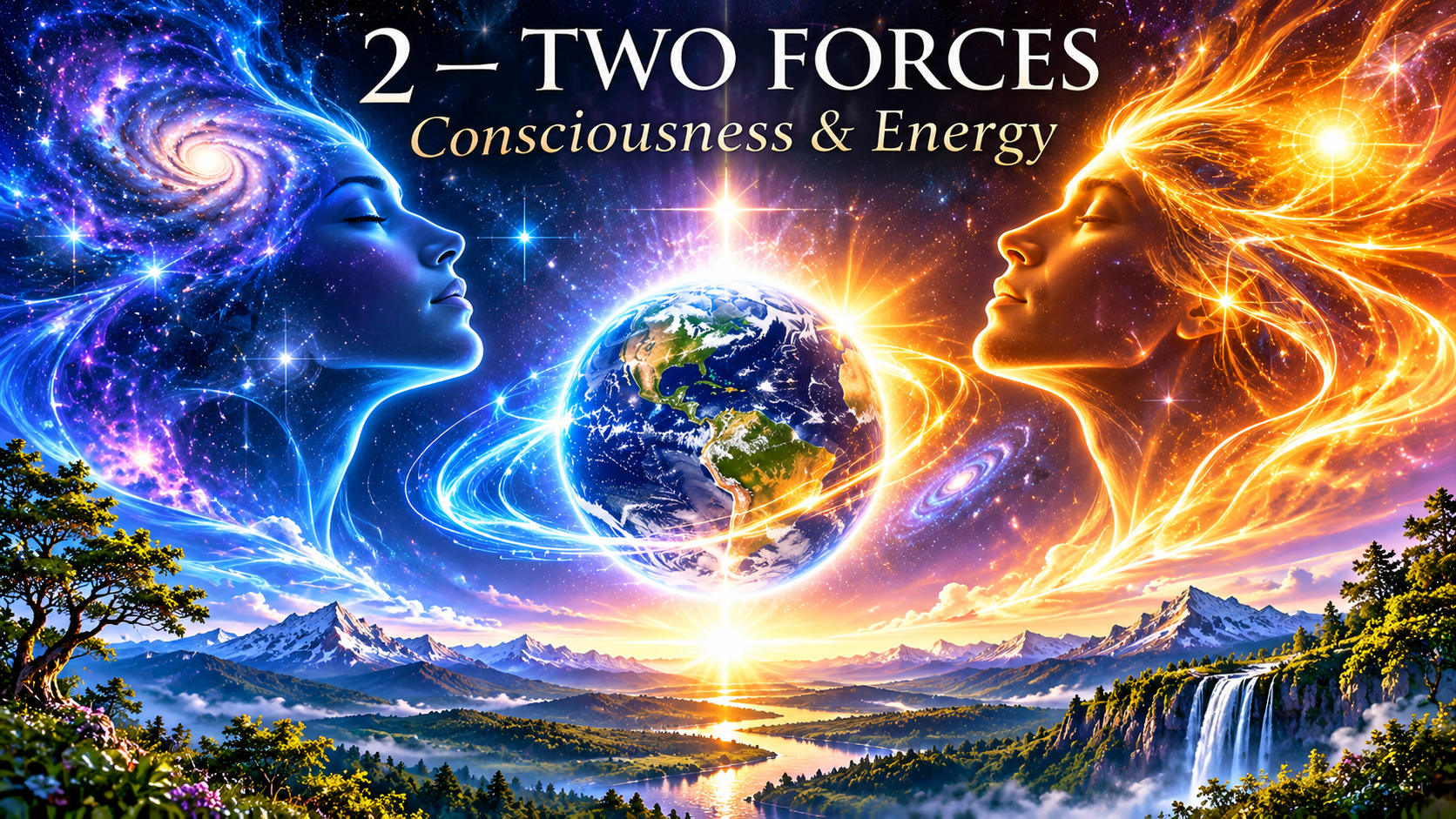
The Twelve Numbers of Creation — Number Two
Principle: Two Forces | Concepts: Consciousness and Energy | Theme: Polarity, Balance and the Expression of Existence
What if the extraordinary diversity of the Universe could be explored through two complementary principles — one associated with awareness and observation, and the other with movement and transformation? Within my Conscious Energy philosophy, these two principles offer a symbolic way of understanding how the Universe becomes a place of endless possibilities, experiences and change.
From One Universe to Two Forces
In the beginning, there was One.
One Universe.
One greater whole containing the foundations of everything that would eventually emerge.
Within the first principle of The Twelve Numbers of Creation, we explored the Universe as a unified existence — an extraordinary reality encompassing space, time, matter, energy and the countless relationships through which physical systems interact.
We contemplated the Source, the origins of the cosmos and the remarkable fact that human beings have developed the ability to observe and question the Universe from which they emerged.
Now, we move beyond the idea of unity and begin exploring the relationships that make diversity and transformation possible.

Within my philosophical framework, I introduce two complementary principles:
Consciousness and Energy.
Consciousness represents the qualities of awareness, observation, information and reflection.
Energy represents the qualities of movement, activity, expression and transformation.
I use these principles to explore the relationship between knowing and doing, stillness and movement, potential and expression.
Although I refer to them as the Two Forces within my framework, they should not be confused with two scientifically established fundamental forces of nature.
Instead, they provide a philosophical model for contemplating how different qualities of existence interact.
One Universe represents the greater whole. Two Forces introduces the complementary principles through which I begin exploring its many expressions.
The Awakening of the Universe
Imagine, for a moment, a Universe resting in an endless slumber.
There is no familiar landscape, no living creature to observe the stars and no voice to question the nature of existence.
Only the possibility of everything that might one day emerge.
Then, like a dream gradually becoming more vivid, the Universe begins to unfold.
Physical structures form.
Matter interacts.
Stars illuminate the darkness.
Galaxies develop.
Planets emerge.
And eventually, under extraordinary circumstances, life appears.
Within my philosophical imagination, I describe this unfolding process as the awakening of the Universe.
It is as though existence gradually develops the ability to recognise and experience itself through the living beings that emerge within it.
Every creature encounters the world through its own sensory and biological capabilities.
Every individual responds to the conditions surrounding them.
And some living organisms, including human beings, possess the capacity to reflect upon their own existence.
We can look towards the stars and ask where we came from.
We can investigate the materials that form our bodies.
We can imagine possibilities beyond our immediate experiences.
Through us, the Universe has produced beings capable of studying the Universe itself.
This is a beautiful idea to contemplate.
However, the image of a Universe awakening is a philosophical metaphor rather than an established account of cosmic history.
Science does not currently demonstrate that the Universe as a whole possesses a mind, emotions or intentions.
Nor do we know whether life exists elsewhere in the cosmos, although the possibility remains an important subject of scientific investigation.
Nevertheless, the metaphor invites us to consider an extraordinary relationship:
The Universe has given rise to conscious beings who can contemplate the very reality from which they emerged.
Perhaps this is one of the most remarkable expressions of existence.
What Is Consciousness?
Consciousness is one of the most fascinating and challenging subjects in science and philosophy.
At its most familiar level, consciousness refers to our capacity for subjective experience.
It is the awareness that accompanies seeing a colour, hearing a sound, feeling an emotion or recognising ourselves as individuals.
Consciousness allows us to experience the world from a personal perspective.
We do not simply receive information from our surroundings.
Our brains process sensory signals, integrate information with memories and expectations, and contribute to the experiences through which we understand reality.
We recognise familiar faces.
We anticipate future events.
We imagine possibilities.
We remember meaningful experiences.
And we develop a sense of identity through our interactions with the world.
Yet important questions remain.
Why do certain biological processes give rise to subjective experience?
How does the brain integrate information into conscious awareness?
And how does consciousness relate to the physical processes that support it?
These questions continue to inspire scientific investigation and philosophical debate.
Within my Conscious Energy framework, I associate Consciousness with the following qualities:
- Awareness and observation
- Information and interpretation
- Reflection and contemplation
- Memory and understanding
- Stillness and receptivity
- Organisation and stability
These associations form the symbolic foundation of my model.
They do not mean that consciousness is scientifically identical to information, stillness or any particular physical force.
Rather, they provide a way of exploring the role of awareness in our experience of existence.
Consciousness is the principle through which I explore the capacity to observe, interpret and understand.
Consciousness as the Mind of Experience
Within The Earth & Body Connection, I associate Consciousness with the Mind.
Our minds allow us to develop thoughts, intentions and interpretations of the world around us.
Consider something as simple as deciding to plant a tree.
Before the tree is planted, we may imagine where it will grow.
We consider the soil, sunlight and available space.
We remember what we have learned about caring for plants.
We decide which tools and materials will be required.
Through this process, the mind helps us plan and organise our actions.
Eventually, we translate those intentions into physical activity.
We prepare the soil.
We position the tree.
We water its roots.
And over time, the tree may grow into a living part of its environment.
Within my framework, this sequence illustrates the relationship between Consciousness and Energy.
Consciousness provides the awareness through which we consider possibilities. Energy allows physical processes and actions to unfold.
However, thought does not always precede action.
Many biological responses occur automatically or before we become consciously aware of them.
Our bodies regulate countless processes without deliberate thought, and our brains are physically active even during quiet reflection.
The relationship between awareness and action is therefore more complex than a simple command from mind to body.
Nevertheless, the distinction remains useful as a philosophical analogy.
It encourages us to consider how reflection and activity can complement one another.
What Is Energy?
Energy is fundamental to the physical Universe.
In science, energy is a measurable property of physical systems, associated with their capacity to undergo change.
It exists in different forms, including kinetic, potential, thermal, chemical and electromagnetic energy.
Energy can be transferred and transformed through physical processes.
Stars emit radiation.
Water moves through rivers.
Plants capture energy from sunlight.
Animals obtain usable chemical energy through food.
Our bodies depend upon continuous energy transformations to sustain biological activity.
Unlike Consciousness, which remains a subject of debate regarding its precise nature and explanation, energy is a well-defined concept within physics.
However, within my philosophical framework, I use the word Energy in a broader symbolic sense.
I associate it with qualities such as:
- Movement and activity
- Transformation and change
- Expression and creativity
- Action and motivation
- Growth and development
- Physical interaction
These qualities represent the active and expressive side of my model.
They invite us to consider the role of movement and transformation in the unfolding story of existence.
Energy is the principle through which I explore activity, expression and change.
Energy as the Spirit of Expression
Within my framework, I associate Energy with the Spirit.
I use Spirit to represent the motivating and expressive qualities of our existence — the desire to explore, participate, create and transform our surroundings.
Consider the moment when an idea becomes an action.
You may imagine painting a picture.
You choose the colours.
You prepare your materials.
You begin moving the brush across the canvas.
Gradually, an image emerges.
The completed painting reflects the relationship between imagination, physical activity and the materials used to create it.
In this example, the mind contributes intention and creative direction.
The body performs the necessary movements.
Physical energy supports the biological processes involved.
Within my philosophy, Spirit symbolises the expressive quality of this process.
It is the movement from possibility into experience.
However, Spirit should not be confused with a scientifically established energy substance stored within the body.
Our physical activity depends upon biological mechanisms involving metabolism, cellular processes, nervous-system signalling and muscular function.
The spiritual interpretation adds a philosophical dimension to these processes rather than replacing their scientific explanations.
Where Consciousness invites us to consider what might be possible, Energy represents the activity through which possibilities may become part of our experience.
The Relationship Between Thought and Action
Every day, we move between reflection and activity.
We observe our surroundings.
We consider our needs.
We make decisions.
We respond to opportunities and challenges.
Some decisions require careful contemplation.
Others occur almost automatically.
The relationship between thinking and doing influences many aspects of our lives.
Imagine preparing a meal.
You recognise that you are hungry.
You consider the ingredients available.
You decide what to prepare.
You gather the necessary materials and begin cooking.
Your brain coordinates complex processes involving perception, memory, movement and attention.
Your muscles perform physical actions supported by energy released through cellular metabolism.
The completed meal becomes the result of numerous interacting processes.
Within Conscious Energy, I use this relationship to illustrate the complementary qualities of awareness and activity.
Reflection without action may leave an intention unrealised.
Action without sufficient awareness may lead to unnecessary mistakes or unintended consequences.
Yet neither principle is inherently superior.
Different circumstances require different combinations of contemplation and activity.
Sometimes the wisest response is to act.
At other times, it is to observe, reconsider or rest.
Balance emerges not from choosing one principle over the other, but from recognising what each situation requires.
Polarity: The Relationship Between Opposing Qualities
One of the central inspirations behind Conscious Energy is the concept of polarity.
Throughout the natural world, we encounter systems involving differences, contrasts and complementary relationships.
Positive and negative electrical charges.
Attraction and repulsion.
Expansion and contraction.
Movement and stillness.
Day and night.
These examples do not all operate through the same scientific mechanisms.
However, they provide symbolic inspiration for exploring the relationship between contrasting qualities.
Within my framework, I represent Consciousness and Energy through negative and positive polarity.
Consciousness (−) represents the receptive, reflective and organisational qualities of existence.
Energy (+) represents the active, expressive and transformative qualities.
The symbols are philosophical associations rather than literal electrical charges assigned to consciousness or spiritual energy.
In physics, positive and negative charge are measurable properties of particles and systems.
Electrons carry negative electrical charge, while protons carry positive electrical charge.
These charges do not establish that electrons possess consciousness or that protons represent a spiritual energy force.
Nevertheless, the interaction of opposing charges provides an interesting metaphor for complementary relationships.
Rather than viewing opposites as necessarily conflicting, we can consider how different qualities may contribute to a larger system.
Within my philosophy, polarity represents the possibility that contrasting principles can participate in a shared process of existence.

Consciousness and Energy Across the Electromagnetic Spectrum
Another source of inspiration for my framework is the electromagnetic spectrum.
Electromagnetic radiation exists across a wide range of wavelengths and frequencies.
This spectrum includes radio waves, microwaves, infrared radiation, visible light, ultraviolet radiation, X-rays and gamma rays.
As electromagnetic frequency increases, the energy carried by each photon also increases.
The visible light spectrum occupies a relatively small portion of this enormous range.
Yet it is particularly meaningful to human experience because our eyes can detect these wavelengths.
Visible light allows us to perceive the colours, shapes and visual qualities of our surroundings.
Within Conscious Energy, I use the electromagnetic spectrum as a symbolic representation of complementary extremes.
At the lower-frequency end, I associate Consciousness with stillness, receptivity and observation.
At the higher-frequency end, I associate Energy with activity, transformation and expression.
Between these symbolic extremes, I place visible light as a representation of balance and harmony.
This is not a claim that low-frequency radiation is literally consciousness, or that high-frequency radiation is inherently more spiritually energetic.
Nor does the visible light band represent a scientifically established equilibrium between consciousness and energy.
Rather, the spectrum provides a visual metaphor for the relationship between different qualities.
It also inspires the colour symbolism of my Rainbow Bridge of Life.
The visible spectrum reminds me that diversity can emerge within a continuous whole, with each colour contributing to the experience of light.

The Consciousness–Energy Ratio: Finding Balance
From these complementary principles, I have developed another concept within my philosophy:
The Consciousness–Energy Ratio, or CER.
The CER is a proposed conceptual model for exploring the relationship between reflection and activity, stability and change, observation and expression.
Imagine someone who spends much of their time contemplating possibilities.
They may possess valuable ideas, knowledge and insights.
However, they may struggle to translate their intentions into action.
Now imagine someone who is constantly active.
They may accomplish many tasks and enjoy movement and stimulation.
Yet without opportunities for reflection, they may become exhausted or overlook important considerations.
Within my framework, these examples illustrate different expressions of Consciousness and Energy.
Neither person is necessarily more balanced or capable than the other.
Our needs, abilities, circumstances and preferences differ.
A healthy balance does not require equal amounts of contemplation and activity at every moment.
Instead, it involves responding appropriately to the demands of our circumstances.
At present, the CER remains a philosophical proposal rather than a scientifically validated measurement.
For it to become a testable psychological or behavioural model, its concepts would need clear definitions, reliable measurements and evidence demonstrating that the proposed relationships exist.
Nevertheless, it offers a useful starting point for personal reflection.
We might ask:
Am I allowing enough time to think before making important decisions?
Am I taking meaningful action towards the things that matter to me?
Do I recognise when my body needs rest?
Am I creating opportunities for learning, exploration and growth?
Balance is not a fixed destination. It is an ongoing relationship between our needs, actions and circumstances.
When Consciousness and Energy Become Unbalanced
Within everyday life, we may experience periods when our patterns of reflection and activity no longer support our wellbeing.
Sometimes we become overwhelmed by constant demands.
We move from one responsibility to another without sufficient opportunities to rest.
Our attention becomes focused on completing tasks, meeting expectations and responding to external pressures.
At other times, we may become caught in repetitive thinking.
We analyse possibilities, anticipate problems and reconsider decisions without finding a clear way forward.
These experiences can be influenced by many factors, including stress, health, sleep, relationships and environmental circumstances.
Within my philosophy, I use the relationship between Consciousness and Energy to encourage awareness of these changing needs.
When we feel mentally overwhelmed, we may benefit from simplifying our responsibilities, resting or seeking support.
When we feel physically restless, movement or meaningful activity may help us reconnect with our surroundings.
When we feel uncertain, reflection and information gathering may provide clarity.
When we feel stuck, taking a small practical step may help us move forward.
These are not universal solutions, nor does the Conscious Energy framework provide a medical explanation for mental or physical health conditions.
Rather, it offers a reflective approach to considering how awareness and activity contribute to our daily experience.
Sometimes we need to slow down and observe. Sometimes we need to move forward and act. Wisdom lies in recognising the difference.
Matter: The Physical Expression of Existence
Having explored Consciousness and Energy as two complementary principles, we arrive at another essential dimension of the framework:
Matter.
Matter forms the physical structures through which we experience the world.
From atoms and molecules to planets, plants, animals and human bodies, matter provides the tangible forms that make up our surroundings.
Our senses allow us to interact with these physical structures.
We see light reflected or emitted by objects.
We hear vibrations transmitted through a medium.
We experience touch through interactions involving our bodies and surroundings.
We perceive tastes and smells through chemical interactions with specialised sensory receptors.
These experiences are supported by biological processes that allow the brain to interpret sensory information.
Within my philosophical model, I describe Matter as the physical expression through which the relationship between Consciousness and Energy becomes meaningful to our experience.
I sometimes express this relationship as:
Consciousness — Mind
Energy — Spirit
Matter — Body
This symbolic arrangement forms the foundation for the next stage of the Twelve Numbers of Creation.
It does not mean that consciousness and energy scientifically combine to produce matter through an established three-part mechanism.
Rather, it represents my way of exploring three interconnected dimensions of human experience:
Awareness.
Activity.
Physical existence.
Matter provides the physical world through which awareness and activity become part of our lived experience.
The Universe as a Tapestry of Existence
Imagine the Universe as an immense tapestry.
Every thread contributes to a larger pattern.
Some threads represent the physical structures of existence.
Others symbolise the relationships, movements and transformations that occur throughout time.
Within this tapestry, living organisms develop their own unique patterns.
A tree responds to sunlight, water and the conditions of its environment.
An animal explores its surroundings, searches for food and responds to other living beings.
A human being develops memories, aspirations, relationships and an understanding of personal identity.
Each form of life participates in the world differently.
Yet every organism depends upon relationships with its environment.
Within my philosophy, Consciousness and Energy provide a symbolic language for exploring these relationships.
Consciousness represents the qualities through which experience is observed and interpreted.
Energy represents the activity and transformation occurring within physical systems.
Matter provides the structures through which these processes become tangible.
Together, these concepts encourage us to contemplate existence as an interconnected story rather than a collection of unrelated events.
We are not separate from the tapestry of existence. Through our bodies, experiences and actions, we participate in its unfolding patterns.
Consciousness, Energy and the Human Experience
The relationship between awareness and activity becomes especially meaningful when we consider our everyday lives.
Our thoughts influence many of our decisions.
Our actions affect our surroundings.
Our experiences shape our memories and understanding.
And our bodies provide the biological means through which these interactions occur.
Consider the simple act of helping another person.
You notice that someone is struggling.
You recognise their need.
You consider whether you can offer assistance.
You decide to act.
Through your body, you provide practical support.
The experience may influence both you and the person receiving help.
Within Conscious Energy, this interaction symbolises the movement between awareness and expression.
We recognise a situation.
We respond through action.
And the consequences become part of our shared experience.
This relationship can be found in countless aspects of life.
Learning a new skill.
Creating a piece of art.
Caring for a garden.
Building a relationship.
Supporting a community.
Exploring the natural world.
In each case, awareness and activity contribute to the way we participate in existence.
Our experiences are shaped not only by what we observe, but also by how we respond to the world around us.
From Two Forces to Three Aspects of Being
The second principle of the Twelve Numbers of Creation introduces the complementary relationship between Consciousness and Energy.
Within my philosophy, these concepts provide a foundation for exploring awareness, activity and transformation.
Yet our experience of existence requires another important consideration.
The physical body.
Our bodies allow us to perceive our surroundings, perform actions and participate in relationships.
They connect our inner experiences with the external world.
This brings us to Number Three:
Three Aspects of Being — Mind, Body and Spirit.
Within this next stage, we will explore how the symbolic principles of Consciousness and Energy relate to the physical expression of Matter.
We will consider how the mind contributes to awareness, how the body supports our experiences and how the concept of spirit can represent meaning, motivation and expression.
Together, these three aspects form another layer of my philosophical understanding of existence.
Consciousness invites us to observe. Energy inspires us to act. Matter provides the physical means through which life is experienced.
A Personal Reflection: Understanding Your Own Balance
Take a moment to consider how reflection and activity influence your daily life.
You might ask yourself:
- Do I naturally spend more time contemplating possibilities or taking action?
- When do I feel most mentally clear and physically capable?
- Am I allowing enough time for rest, reflection and meaningful activity?
- How do my thoughts influence the decisions I make?
- Are there areas of my life where I feel stuck between thinking and doing?
- What activities help me feel connected to my body and surroundings?
- How might greater awareness of my needs improve the way I use my time and energy?
- What is one practical change I could make to create a healthier balance between reflection and action?
There are no right or wrong answers.
Our circumstances, personalities and needs differ.
The purpose of these questions is not to place ourselves into fixed categories.
It is to encourage greater awareness of the relationships between our thoughts, actions and experiences.
Perhaps the most meaningful question is:
What if a more fulfilling life begins with understanding when to observe, when to act and when to allow ourselves to rest?

The Wisdom of Two: Complementary Principles Within One Universe
The second number of creation invites us to explore the relationship between two complementary qualities of existence.
Consciousness and Energy.
Awareness and activity.
Reflection and expression.
Stability and transformation.
Within my philosophy, these principles provide a symbolic way of contemplating how different aspects of existence interact.
They encourage us to recognise that meaningful experiences often involve both observation and participation.
We learn by paying attention.
We grow through experience.
We create through imagination and action.
We develop understanding through reflection.
And we contribute to the world through the choices we make.
The Universe itself contains extraordinary diversity, from the immense structures of galaxies to the intricate biological systems that support life.
Although these physical processes are explained through established scientific principles, they also inspire deeper philosophical questions about the nature of reality.
For me, Conscious Energy offers one way of exploring these questions.
Not as a replacement for science, but as a framework for considering the relationships between existence, experience and meaning.
One Universe is the foundation.
Consciousness and Energy are the two complementary principles.
Balance is the relationship we seek to understand.
And through the physical world, we discover the extraordinary diversity of experiences that make life possible.
Perhaps the beauty of existence lies not in one principle overcoming another, but in recognising how different qualities contribute to a greater whole.
Two Principles. One Universe. Countless Possibilities.
This article forms part of The Twelve Numbers of Creation, an original philosophical framework developed through The Earth & Body Connection. Conscious Energy and the Consciousness–Energy Ratio are conceptual models rather than established scientific theories. References to electrical polarity, the electromagnetic spectrum, Mind, Body and Spirit are used partly as symbolic analogies. Scientific consciousness, physical energy and matter have distinct meanings, and the proposed relationships within this framework should not be interpreted as scientifically demonstrated mechanisms of creation.
Next in the series: Three Aspects of Being — Mind, Body and Spirit.
Leave a Reply