

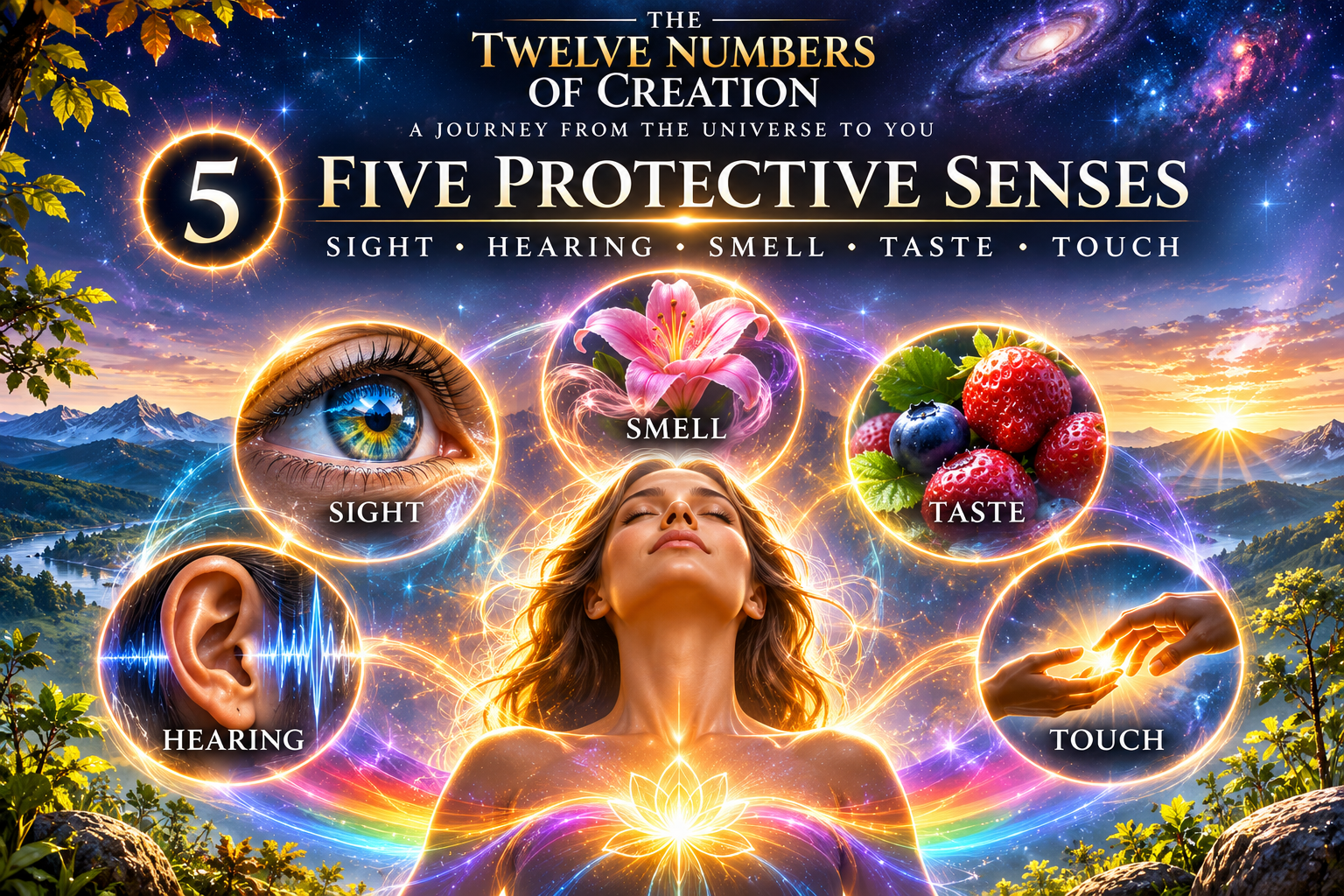
The Twelve Numbers of Creation — Number Five
Principle: Five Protective Senses | Concepts: Sight, Hearing, Smell, Taste and Touch | Theme: Perception, Awareness and Survival
What if our senses are more than windows into the physical world? What if they also provide the foundation through which we develop awareness, protect ourselves, form memories and discover what it means to be alive?
From Four Elements to Five Protective Senses
Our journey through the Twelve Numbers of Creation began with the concept of One Universe — an extraordinary physical reality containing everything we observe.
We then explored Two Forces — Consciousness and Energy, introducing the complementary principles of awareness and activity within my philosophical framework.
The third principle introduced Three Aspects of Being — Mind, Body and Spirit, examining the relationship between understanding, physical existence and meaningful expression.
The fourth principle explored Four Elements of Nature — Air, Water, Earth and Fire, using the classical elements as symbolic representations of the materials and processes that shape our environment.
Now, we arrive at the fifth principle:
Five Protective Senses — Sight, Hearing, Smell, Taste and Touch.
Here, our exploration moves from the physical conditions of the Universe towards the ways living organisms encounter and respond to those conditions.
We begin to consider a remarkable question:
How does a living organism become aware of the world around it?
Our senses provide an important part of the answer.
Through sensory systems, we detect light, sound, chemical substances, pressure, temperature and numerous other environmental conditions.
Our nervous systems process this information, allowing us to recognize patterns, respond to changes and develop an understanding of our surroundings.
These processes are essential for survival, but their importance extends far beyond protection.
Our senses also allow us to experience beauty, develop relationships, communicate, learn and participate meaningfully in life.
The colors of a sunset.
The sound of a familiar voice.
The fragrance of flowers.
The taste of a favorite meal.
The warmth of another person’s hand.
Each experience begins with physical interactions between our bodies and the environment.
Yet the meaning we attach to these experiences develops through perception, memory, emotion and interpretation.
Our senses connect the physical world with our individual experience of reality.
Why Do Living Organisms Need Sensory Systems?
Life exists within environments that are continually changing.
Temperatures fluctuate.
Resources become available or scarce.
Predators and other hazards may appear.
Opportunities for nourishment, shelter and reproduction change over time.
For organisms to survive, they must respond appropriately to relevant conditions.
Throughout evolutionary history, sensory systems developed in diverse forms, allowing organisms to detect and respond to information in their environments.
These systems differ considerably between species.
Some animals possess highly developed vision.
Others rely heavily upon smell, hearing or touch.
Certain organisms can detect magnetic fields, electrical signals or wavelengths of light beyond the range of ordinary human vision.
These differences reflect the varied ecological conditions and evolutionary histories of living organisms.
Human beings possess sophisticated sensory systems that support our ability to navigate complex environments.
Our senses help us recognize food, identify hazards, communicate with others and coordinate movement.
However, their function is not limited to conscious awareness.
Many sensory responses occur automatically, without requiring deliberate thought.
For example, a sudden loud sound may trigger a startle response before we consciously identify its source.
Similarly, contact with a dangerously hot surface can activate a rapid withdrawal reflex.
These protective mechanisms demonstrate how sensory information contributes to the regulation and protection of the body.
Within my Conscious Energy philosophy, I interpret this relationship as an interaction between awareness and activity.
Consciousness symbolizes our capacity to recognize and interpret experience.
Energy symbolizes the activity involved in responding to that experience.
The body provides the physical systems through which these processes occur.
This is a philosophical interpretation of biological processes, rather than a claim that consciousness and spiritual energy operate as separate measurable forces.
The ability to detect and respond to environmental information is one of the remarkable characteristics of living systems.
The Five Senses: A Traditional Framework for Human Perception
For generations, human perception has commonly been described through five senses:
- Sight — the detection of light.
- Hearing — the detection of sound.
- Smell — the detection of airborne chemical substances.
- Taste — the detection of chemicals in food and other substances.
- Touch — the detection of physical contact and related sensations.
This traditional classification provides a useful introduction to the ways we experience our surroundings.
However, modern neuroscience recognizes that human sensory experience is more extensive.
We also possess systems that contribute to balance, awareness of body position, pain, temperature and the internal condition of our bodies.
These additional processes are important for movement, survival and physiological regulation.
Within the Twelve Numbers of Creation, I retain the traditional Five Senses because they provide a familiar symbolic foundation for exploring our relationship with the external world.
They represent five important pathways through which information from our surroundings becomes part of our lived experience.
1. Sight: Observing the World Through Light
Sight allows us to perceive the visual characteristics of our environment.
Through vision, we recognize colors, shapes, movement, patterns and spatial relationships.
Our eyes detect light reflected or emitted by objects.
Light enters the eye and reaches the retina, where specialized cells called photoreceptors respond to incoming light.
Rods contribute particularly to vision under low-light conditions.
Cones support color vision and visual detail under suitable lighting conditions.
These cells initiate processes that convert light-related information into neural signals.
The information travels through visual pathways to the brain, where it is processed and integrated.
Our visual experience emerges through complex neural activity rather than through the brain receiving a complete photographic image.
Sight as a Protective Sense
Vision contributes to our ability to identify potential hazards.
We can observe approaching vehicles.
Recognize changes in terrain.
Detect movement.
Notice signs of danger.
And navigate unfamiliar environments.
Visual information also supports coordination between the eyes and body.
For example, when walking along an uneven path, our visual system helps us anticipate obstacles and adjust our movements.
These processes contribute to safer navigation and more effective interaction with our surroundings.
Sight, Color and the Visible Light Spectrum
One of the most remarkable aspects of vision is our ability to perceive color.
Visible light represents a relatively narrow portion of the electromagnetic spectrum.
Different wavelengths of visible light contribute to the colors we perceive, although color experience also depends upon how the visual system processes incoming information.
Within my Conscious Energy philosophy, the visible light spectrum holds particular symbolic significance.
I use the seven familiar colors of the rainbow to represent stages of human experience within the Rainbow Bridge of Life.
Red represents Survival.
Orange represents Creativity.
Yellow represents Identity.
Green represents Relationships.
Blue represents Connectedness.
Indigo represents Guidance.
Violet represents Release.
These relationships are philosophical and symbolic rather than scientifically established correspondences between wavelengths and stages of human development.
Nevertheless, the spectrum provides a meaningful visual language for exploring the diversity of human experience.
The Deeper Meaning of Sight
Sight allows us to observe the physical world, but observation is not identical to understanding.
Two people may witness the same event yet interpret it differently.
Their memories, expectations, attention and previous experiences may influence what they notice and how they respond.
This reminds us that perception involves both sensory information and interpretation.
Within my philosophy, Sight symbolizes the importance of awareness.
To see is to receive information. To understand is to develop meaning from what we perceive.
2. Hearing: Recognizing Sound and Communication
Hearing allows us to detect sound produced by vibrations traveling through a medium.
Sound waves move through substances such as air, water and solids.
When sound reaches the ear, it causes mechanical vibrations that are transmitted through structures of the auditory system.
Within the inner ear, specialized hair cells convert mechanical movement into neural signals.
These signals travel through auditory pathways and are processed by the brain.
Through this process, we recognize speech, music, environmental sounds and numerous other auditory experiences.
Hearing as a Protective Sense
Hearing provides information about events that may occur outside our immediate field of vision.
We may hear footsteps approaching from behind.
Recognize an emergency alarm.
Detect an approaching vehicle.
Or respond to another person’s call for help.
Hearing also contributes to spatial awareness.
By comparing differences in the timing and intensity of sounds reaching each ear, the auditory system helps us estimate the direction of a sound source.
This information can support rapid responses to environmental changes.
Hearing and the Development of Relationships
Beyond protection, hearing plays an important role in communication.
Through spoken language, we exchange information, express emotions and develop relationships.
The tone, rhythm and volume of a person’s voice may contribute to how we interpret their message.
A familiar voice can evoke feelings of comfort or recognition.
Music can influence mood and evoke memories.
Environmental sounds can remind us of meaningful places and experiences.
These associations develop through interactions among auditory processing, learning, memory and emotion.
The Deeper Meaning of Hearing
Within my philosophy, Hearing symbolizes communication, understanding and connection.
Listening involves more than detecting sound.
It can also require attention, patience and a willingness to consider another person’s perspective.
We may hear someone’s words without fully understanding their meaning.
We may also recognize emotion through changes in tone, rhythm or expression.
Developing the ability to listen thoughtfully can contribute to healthier communication and stronger relationships.
Hearing allows us to detect sound. Listening creates opportunities for understanding.
3. Smell: Detecting Chemical Information
Our sense of smell, known as olfaction, allows us to detect certain chemical substances present in the air.
When odour molecules enter the nasal cavity, they can interact with specialized receptors associated with olfactory sensory neurons.
These receptors initiate signals that travel to the olfactory bulb and other brain regions involved in processing smell.
The brain interprets patterns of activity associated with different odours.
Smell is closely connected with memory and emotion, which helps explain why familiar scents can evoke powerful personal associations.
Smell as a Protective Sense
Smell can provide information about environmental conditions.
We may notice smoke.
Recognize the odour of spoiled food.
Detect certain chemical substances.
Or identify changes in our surroundings.
However, smell is not a completely reliable safety system.
Some hazardous substances have little or no detectable odour, while others may be harmful before a person recognizes their presence.
For this reason, sensory perception should not replace appropriate safety equipment or established precautions.
Smell, Memory and Emotion
Consider the fragrance of freshly cut grass.
For one person, it may evoke memories of childhood.
For another, it may remind them of gardening or spending time outdoors.
A particular perfume may bring to mind someone important.
The smell of a familiar meal may recall family gatherings.
These experiences demonstrate how sensory information can become associated with memories and emotions.
Our responses to smells are influenced by both biological processes and individual experience.
The Deeper Meaning of Smell
Within my philosophy, Smell symbolizes recognition and memory.
It reminds us that even subtle sensory experiences can influence our relationship with the world.
Not every meaningful experience requires conscious attention.
Sometimes, a familiar scent can bring an important memory into awareness unexpectedly.
Smell reminds us that our experiences are connected through memory, association and emotion.
4. Taste: Evaluating Nourishment and Chemical Information
Taste allows us to detect certain chemical characteristics of substances entering the mouth.
Specialized taste receptor cells respond to compounds associated with the five commonly recognized basic tastes:
Sweet, Sour, Salty, Bitter and Umami.
These responses contribute to our evaluation of food and other substances.
Taste information is transmitted through neural pathways to regions of the brain involved in sensory processing.
Our experience of flavor also depends upon smell, texture, temperature and other sensory information.
This explains why food may taste different when our sense of smell is temporarily reduced.
Taste as a Protective Sense
Taste can contribute to the evaluation of potential food sources.
Sweetness may be associated with energy-containing sugars.
Saltiness can provide information about certain mineral compounds.
Bitterness may help identify some potentially harmful substances.
Sourness can indicate acidity.
Umami is associated with compounds such as glutamate.
However, these relationships are not absolute.
Some poisonous substances may taste pleasant, while nutritious foods may taste bitter.
Taste alone cannot determine whether something is safe to consume.
Taste and Human Experience
Food is more than a source of nutrients.
It is also connected to culture, family, celebration and memory.
A familiar meal may remind us of home.
A new flavor may encourage curiosity.
Sharing food can strengthen social relationships.
Preparing meals can become an expression of creativity, generosity and care.
Through these experiences, taste contributes to both physical nourishment and social connection.
The Deeper Meaning of Taste
Within my philosophy, Taste symbolizes discernment and nourishment.
It encourages us to consider what we allow into our lives and how our choices influence our well-being.
Just as we learn to evaluate foods through experience and knowledge, we also develop the ability to assess information, relationships and opportunities.
This is a metaphor rather than a literal equivalence between taste perception and judgment.
Nevertheless, it offers a useful reflection.
Taste reminds us that nourishment involves both receiving and evaluating what the world provides.
5. Touch: Understanding the World Through Physical Contact
Touch allows us to detect physical interactions between our bodies and the environment.
Specialized sensory receptors contribute to our perception of pressure, vibration, skin movement and other forms of mechanical stimulation.
Temperature and pain are detected through related but distinct sensory pathways.
These signals travel through the nervous system and contribute to our awareness of bodily conditions.
Touch is particularly important because it allows us to interact directly with physical objects.
Through touch, we recognize texture, shape and resistance.
We manipulate tools.
Coordinate movements.
Explore unfamiliar materials.
And respond to potentially harmful contact.
Touch as a Protective Sense
Touch-related sensory systems contribute to the body’s ability to respond to physical hazards.
When we encounter a sharp object, pressure or potentially damaging heat, sensory information can trigger protective responses.
Some responses occur through rapid spinal reflex pathways.
Others involve conscious awareness and deliberate action.
Together, these processes help protect the body from injury.
Touch and Human Connection
Touch also plays an important role in social and emotional experiences.
A reassuring hand on the shoulder may communicate support.
A hug may express affection.
Holding hands may strengthen feelings of connection.
However, physical contact is experienced differently by different people.
Personal boundaries, cultural expectations, sensory sensitivities and individual preferences influence whether touch feels welcome or uncomfortable.
Respectful touch therefore requires attention to consent and personal comfort.
The Deeper Meaning of Touch
Within my philosophy, Touch symbolizes physical connection and the importance of boundaries.
It reminds us that our bodies allow us to interact directly with the world.
Yet it also encourages us to recognize that meaningful connection depends upon respect.
We can express care through touch when it is welcomed.
We can also express care by respecting another person’s need for physical space.
Touch reminds us that connection is most meaningful when accompanied by awareness, respect and consideration.
Beyond the Five Senses: The Greater Complexity of Human Perception
Although the traditional Five Senses provide a useful framework, our sensory experience is more complex.
Modern neuroscience recognizes additional sensory systems that contribute to our ability to navigate the world and regulate our bodies.
Proprioception: Knowing Where Our Body Is
Proprioception contributes to our awareness of the position and movement of our body parts.
It allows us to coordinate movement without constantly watching our limbs.
For example, we can often touch our nose with our eyes closed because sensory information helps the nervous system estimate the position of our hand.
The Vestibular Sense: Balance and Orientation
The vestibular system, located within the inner ear, contributes to balance and the detection of head movement.
It works alongside visual and proprioceptive information to support posture, coordination and spatial orientation.
Interoception: Awareness of Internal Conditions
Interoception involves sensing and interpreting signals related to the internal condition of the body.
These may include sensations associated with hunger, thirst, breathing, heartbeat and other physiological processes.
Interoception can contribute to emotional experience and the regulation of bodily needs.
Pain and Temperature
Pain and temperature perception involve specialized sensory processes that help us respond to potentially harmful conditions.
These systems provide information that supports protection and physiological regulation.
Together, these additional senses remind us that awareness is not directed exclusively towards the external world.
Our nervous systems continuously process information about both our surroundings and our internal bodily conditions.
This relationship becomes particularly important as we move towards the next stage of the Twelve Numbers of Creation.
Our senses allow us to experience the world outside us while also contributing to our awareness of the world within.
How the Brain Creates Our Experience of Reality
Our sensory systems do not provide an exact, complete representation of the external world.
Instead, they detect particular forms of physical information.
The brain processes this information through complex neural networks, integrating it with memory, attention, expectations and other signals.
The resulting experience allows us to navigate our surroundings and respond to meaningful events.
However, perception is not infallible.
Optical illusions demonstrate that visual experience can differ from physical measurements.
Auditory illusions reveal how the brain interprets ambiguous sound patterns.
Memories can influence how we interpret familiar situations.
Emotions and expectations can affect what we notice.
These examples raise an important philosophical question:
If our experience of reality depends upon perception, how do we distinguish the world itself from our interpretation of it?
Scientific investigation addresses this question by comparing subjective reports with observable and measurable events.
Through controlled experiments, researchers can investigate how sensory information is processed and why perceptual errors occur.
Yet the subjective character of conscious experience remains an important topic within neuroscience and philosophy.
We can measure neural activity associated with perception.
We can investigate sensory pathways.
We can examine behavioral responses.
But understanding why these processes are accompanied by subjective experience remains a subject of ongoing research.
Within my Conscious Energy philosophy, I use the relationship between Consciousness and Energy as a symbolic way of exploring this interaction.
Consciousness represents the qualities of awareness and interpretation.
Energy represents the activity involved in physiological and behavioral responses.
Matter represents the physical structures through which these processes occur.
This conceptual relationship does not establish consciousness as a separate electrical force or demonstrate that perception creates physical reality.
Instead, it provides a philosophical perspective from which to consider the relationship between experience and action.
Perception is our experience of reality, shaped by the information our bodies receive and the ways our brains interpret it.
From Sensory Experience to Memory and Identity
Our senses contribute to the development of memory and personal identity.
Throughout life, we encounter people, places, objects and events.
Sensory information becomes part of these experiences.
Some events are remembered vividly.
Others are forgotten.
The likelihood of remembering an experience depends upon numerous factors, including attention, emotional significance, repetition and the processes involved in memory formation.
Over time, our memories contribute to our understanding of ourselves.
We develop preferences.
Recognize familiar environments.
Learn skills.
Form relationships.
And establish expectations about the world.
Our identities emerge through complex interactions among biological development, personal experience, social relationships and cultural influences.
Sensory perception contributes to this process, but it is not the sole foundation of identity.
Language, reasoning, emotion, memory and social experience also play important roles.
Within my philosophy, this relationship highlights the significance of the Five Senses as pathways through which the physical world becomes part of our personal story.
Every experience offers an opportunity to learn, adapt and develop a deeper understanding of ourselves.
The Five Senses and the Human Instinct for Survival
Survival is one of the most fundamental biological challenges faced by living organisms.
Organisms must obtain resources, maintain suitable internal conditions and respond to environmental hazards.
Sensory systems contribute to these processes by providing information that supports appropriate behavior.
Throughout human evolutionary history, perception played an important role in activities such as locating food, finding water, identifying shelter, recognizing threats and navigating unfamiliar environments.
The ability to detect environmental changes also supported cooperation and communication within social groups.
Human survival, however, has never depended upon sensory perception alone.
Learning, social relationships, technology, cultural knowledge and collective cooperation have also been essential.
Today, our senses continue to support everyday safety and well-being.
We observe traffic before crossing a road.
Listen for warning signals.
Recognize changes in our environment.
Evaluate food through several senses.
And respond to physical discomfort.
These experiences demonstrate the ongoing relationship between perception and protective behavior.
Within the Rainbow Bridge of Life, Survival forms the first of seven symbolic stages.
Represented by the color Red, this stage explores our fundamental needs for nourishment, security, shelter, rest and physical well-being.
The Five Protective Senses therefore provide a meaningful transition into the Rainbow Bridge.
They represent important biological systems through which we encounter the physical conditions relevant to our survival.
Sensory Diversity: Different Ways of Experiencing the World
An important consideration when exploring human perception is that sensory experiences vary considerably between individuals.
Some people have reduced vision or hearing.
Others experience differences in taste, smell, touch or sensory processing.
Certain individuals may be particularly sensitive to sound, light, texture or other forms of stimulation.
These differences can arise through genetics, development, illness, injury, aging or other factors.
They do not determine a person’s worth, intelligence, emotional depth or capacity for meaningful experience.
Human beings adapt to sensory differences in many ways.
Assistive technologies, accessible environments, communication systems and social support can help individuals participate more fully in everyday life.
For example, people with visual impairments may rely more heavily upon auditory, tactile or other forms of information.
People with hearing differences may communicate through sign languages, visual information, speech or other methods.
These examples remind us that the experience of reality is not identical for everyone.
Within my philosophy, sensory diversity reinforces an important principle:
There is no single way of experiencing the world that defines the value of a human life.
Our differences invite greater understanding, compassion and respect.
The Five Senses Within the Conscious Energy Framework
Having explored the biological foundations of sensory perception, we can return to the broader relationships described within my Conscious Energy philosophy.
The first five numbers of creation introduce a symbolic progression:
One Universe — The Greater Whole
Everything we observe belongs to the physical Universe.
Two Forces — Consciousness and Energy
Awareness and activity represent complementary qualities within my philosophical framework.
Three Aspects of Being — Mind, Body and Spirit
Understanding, physical existence and meaningful expression contribute to our interpretation of human experience.
Four Elements — Air, Water, Earth and Fire
The classical elements symbolize the materials and processes that shape the natural world.
Five Protective Senses — Sight, Hearing, Smell, Taste and Touch
Sensory systems allow us to detect and respond to information from our surroundings.
Together, these principles form the introductory foundation of the Twelve Numbers of Creation.
The progression moves from the wider Universe towards the individual experience of life.
Within my framework, the first five principles represent the outward-facing dimension of existence.
They encourage us to examine the physical world and the processes through which we experience it.
The next seven principles turn our attention towards the human journey.
They explore the development of personal needs, creativity, identity, relationships, connectedness, guidance and release.
This transition is central to the Rainbow Bridge of Life.
Turning Inward: The Beginning of the Rainbow Bridge of Life
The Rainbow Bridge of Life is a seven-color philosophical model exploring recurring themes of human experience.
Each color represents a particular dimension of personal growth.
Red — Survival: To Have
Our fundamental needs for safety, nourishment and security.
Orange — Creativity: To Do
Our capacity to explore, imagine, create and participate.
Yellow — Identity: To Show
Our developing sense of individuality, confidence and self-expression.
Green — Relationships: To Serve
Our experiences of love, compassion, responsibility and connection.
Blue — Connectedness: To Support
Our appreciation of beauty, cooperation and belonging within the wider world.
Indigo — Guidance: To Teach
Our pursuit of wisdom, reflection and the sharing of knowledge.
Violet — Release: To Let Go
Our capacity for acceptance, forgiveness, transformation and relinquishing what no longer serves us.
These stages are symbolic rather than scientifically established developmental phases.
They do not require individuals to progress through a fixed sequence or reach particular milestones at predetermined ages.
Instead, they represent themes that can emerge and re-emerge throughout life.
We may encounter survival challenges during adulthood.
Discover new creative interests later in life.
Reconsider our identities after significant experiences.
Develop meaningful relationships at any age.
And continue learning, teaching and letting go throughout our personal journeys.
Within my philosophy, the Rainbow Bridge provides a reflective framework for considering these experiences.
The Five Protective Senses form the transition between our exploration of the physical Universe and our exploration of the human experience.
Through our senses, we encounter the world. Through our experiences, we begin to discover ourselves.

A Personal Reflection: Experiencing Life Through the Five Senses
Take a moment to consider how your senses contribute to your everyday experiences.
You may wish to reflect upon the following questions.
Sight — Awareness
What do I notice when I take time to observe my surroundings?
Are there aspects of the natural world that I often overlook?
Hearing — Understanding
Am I listening attentively when others communicate?
What sounds bring me comfort, curiosity or enjoyment?
Smell — Memory
Are there familiar scents that evoke meaningful memories?
How do these associations influence my emotional experiences?
Taste — Nourishment
Do I allow myself opportunities to appreciate food and nourishment?
How do culture, memory and relationships influence my experiences of eating?
Touch — Connection
How does physical contact influence my sense of comfort and safety?
Am I respecting my own boundaries and those of others?
These reflections are not intended to assess sensory ability or spiritual development.
They simply encourage greater awareness of the experiences available to us.
Perhaps the most meaningful question is:
How might my relationship with the world change if I approached everyday experiences with greater curiosity, appreciation and attention?
Conclusion: Five Senses, One Human Experience
The fifth number of creation invites us to recognize the extraordinary importance of sensory perception.
Sight. Hearing. Smell. Taste. Touch.
These familiar senses allow us to detect information from our surroundings and respond to the physical conditions of our environment.
They contribute to our protection.
Support learning and memory.
Help us communicate.
And enrich our experiences of the world.
Yet their significance extends beyond biological survival.
Through perception, we encounter the beauty of nature.
We recognize familiar people.
We develop preferences and memories.
We discover opportunities for connection.
And we gradually form an understanding of ourselves within the greater world.
Within my Conscious Energy philosophy, the Five Protective Senses represent the final stage of our outward exploration of existence.
We began with the Universe.
We considered complementary principles.
We explored Mind, Body and Spirit.
We examined the classical elements of nature.
And now, we have arrived at the sensory systems through which the physical world becomes part of our individual experience.
The journey does not end here.
Instead, it begins to change direction.
Having explored the world around us, we can now turn our attention towards the world within.
The Rainbow Bridge of Life invites us to explore the needs, experiences, relationships and transformations that contribute to our personal journeys.
We begin with the first color:
Red — Survival: To Have.
The foundation of life.
The importance of nourishment, shelter, security and physical well-being.
The starting point from which our experiences can unfold.
Within the greater story of existence, our senses remind us of something extraordinary:
We are physical beings capable of experiencing the world around us.
We can observe.
Listen.
Recognize.
Taste.
Touch.
Learn.
Remember.
And connect.
Through these experiences, we develop our own unique perspectives on reality.
One Universe. Two Complementary Principles. Three Aspects of Being. Four Elements of Nature. Five Protective Senses.
Sight — To Observe.
Hearing — To Listen.
Smell — To Recognize.
Taste — To Nourish.
Touch — To Connect.
Five Senses. One Human Experience.
This article forms part of The Twelve Numbers of Creation, an original philosophical framework developed through The Earth & Body Connection. The relationships between Consciousness, Energy, Matter and sensory experience are philosophical interpretations rather than established scientific equivalences. Scientific descriptions of sensory systems are distinguished from symbolic interpretations throughout the article.
Next in the series: Six — Red: Survival, To Have.
Leave a Reply